
How to Rank in Google’s AI Mode in 9 Steps
If you feel like you’re falling behind the curve, you’re not imagining it.
AI Mode is rapidly changing how visibility works in search.
The Product Lead for Google’s AI Studio recently hinted at a future where AI Mode’s features could start to become default in Google Search.

So if your brand isn’t showing up in Google’s AI Mode, you’re going to likely start feeling the market slipping away.
Most businesses are all facing the same problem:
Your ideal buyers are already searching for products like yours in AI Mode. But the answers are filled with your competitors, marketplace roundups, and even Reddit threads.
Not you.
That means you’re invisible at the exact moment they’re ready to make a decision.
As Google continues to roll out AI Mode updates, we’re left with no clear explanation for how actually to show up where it matters most.
You’re left asking: What is Google’s AI looking for? Do I need more citations? More content? Better structured data? And why are my competitors showing up while mine doesn’t even get a mention?
This guide breaks down exactly how AI Mode works, what’s influencing rankings, and most importantly, what you can do today to reverse-engineer your way into AI-generated results.
I’ll walk through the 9 steps top brands are using to win visibility without relying on outdated SEO hacks.
By the end, you’ll have a playbook for showing up inside the answers your ICP is searching BEFORE they buy.
Feel free to skip ahead:
- What’s the Difference Between AI Mode vs. AI Overviews?
- What’s the Business Value of Showing Up in AI Mode?
- Step #1: Reverse Engineer WHY You’re Not Showing Up in AI Mode
- Step #2: Ensure Your Brand has Crystal Clear Positioning
- Step #3: Make it Clear That You’re an Authority in Your Industry with Content
- Step #4: Optimize Your Content To Have Info Easily Extracted From It
- Step #5: Publish as Much Social Proof as Possible
- Step #6: Get More Relevant Brand Mentions for Your Brand
- Step #7: Build Up Your Customer Reviews on Review Sites
- Step #8: Make Sure Your Business Info is Accurate and Up-to-Date Around the Web
- Step #9: Keep Your Content On a Revamp Schedule
What’s the Difference Between AI Mode vs. AI Overviews?
I’ve already written a guide for how to show up in Google’s AI Overviews, so what’s the difference with AI Mode?
The names sound similar, but they serve 2 very different purposes in how search results are delivered.
Let’s break it down in plain English.
AI Overviews = Google’s AI summary in SERPs
When you search for something in regular Google Search, you’ll often see an AI Overview at the top of the page. This is a summary written by Google, pulling info from multiple sources to answer your question quickly.
You don’t opt into it. Google chooses when to show it.
It’s designed to help provide quick answers for more complex questions, like “what’s the difference between probiotics and prebiotics?” or “best project management tools for remote teams.”
The key thing? It still shows links to websites underneath the summary, and those links are carefully selected from Google’s traditional ranking systems. So if your brand appears here, it’s because your page helped support the answer.
AI Mode = Google’s ChatGPT-style search tab
AI Mode is different. It’s a whole separate search experience you can opt into. Instead of 10 blue links or a short AI box, AI Mode feels like you’re chatting with a personal researcher.
When you ask a question here, Google runs multiple mini searches at once behind the scenes, compares sources, uses its Gemini model to reason through it, and then gives you a longer, more thoughtful answer.
It even remembers your past questions and lets you ask follow-ups (just like ChatGPT).
Think of AI Mode as Google’s AI assistant that gives you a full-on briefing, not just a highlight.
What this means for your brand
Showing up in an AI Overview is a great signal. But showing up in AI Mode?
That’s like being handpicked by a consultant to be a trustworthy source in an AI-powered conversation.
Here’s a side-by-side to make it crystal clear:
| Feature | AI Overviews | AI Mode |
| Where it shows up | In regular Google Search results | In the separate AI Mode tab |
| Triggered by | Google (automatic) | User opt-in (manual) |
| Format | Short summary with 3–4 links | Long response + interactive interface |
| Follow-up questions? | No | Yes |
| Personalized output? | Not really | Yes, based on previous inputs |
| Uses structured links? | Yes | Yes, plus wider link diversity |
| Model used | Gemini (basic reasoning) | Gemini (advanced + multimodal reasoning) |
What’s the Business Value of Showing Up in AI Mode?
Let’s be clear up front: AI Mode isn’t going to be a major traffic engine like traditional SERPs.
Users are getting their answers inside the AI interface. There are fewer visible links. And unlike traditional search, AI Mode focuses on providing a direct, insightful answer instead of just a list of resources to manually read through.
Ranking in AI Mode is less about clicks — and more about controlling the narrative so your brand is surfaced when your ideal customer is going through the customer journey.
Here’s why that matters:
1. You show up exactly when your ICP is buying
Just like traditional SEO, the most valuable traffic comes from users with high-intent queries.
Think:
- Best project management tools for startups with remote teams
- Top email marketing platforms for ecommerce
- What’s the cheapest alternative to Semrush?
- CRM with SMS features and white label reports
Showing up for searches like these is what’s going to drive the majority of your revenue from search.
They’re bottom-of-funnel buyer questions that Google’s AI is trying to answer with a shortlist of trusted brands.
If your product isn’t part of that shortlist, you’ve already lost the chance of making a sale.
2. You influence buying decisions — even if nobody clicks
Even if AI Mode doesn’t drive traffic to your blog post or landing page, it still drives perception.
The brands and tools mentioned in an AI answer become the default options in the user’s mind.
Users are increasingly consulting AI chatbots like AI Mode before they even visit your website.
And when they do visit your website, they’re already ready to buy. So they’ll convert, and it’ll be harder to track how exactly they found out about your brand.
Success in AI Mode isn’t being measured in traffic. It’s being measured in your brand presence within the chat experience.
Are you there when it matters? Is your brand showing up when a buyer is comparing options? Is your product name being associated with the category?
If not, you’re invisible at the moment of intent.
3. It’s a future-proof moat for category leadership
AI Mode is a window into how search is evolving.
Every time someone searches a product category, compares options, or evaluates competitors, Google’s AI is building a picture of who matters.
If you’re not appearing in that picture, your competitors are.
The longer they dominate the answers, the harder it’ll be to dislodge them later.
Step #1: Reverse Engineer WHY You’re Not Showing Up in AI Mode
The first step to ranking in AI Mode is simple: See if you’re even part of the conversation.
Start by opening AI Mode and searching bottom-of-funnel queries your ideal customer would ask when they’re actively looking for solutions.
For example:
- For a meal kit service: “best meal kits for picky eaters” or “most affordable meal delivery for families”
- For a local restaurant: “best italian restaurants in Baltimore”
- For a webinar platform: “zoom vs. demio for lead gen webinars”
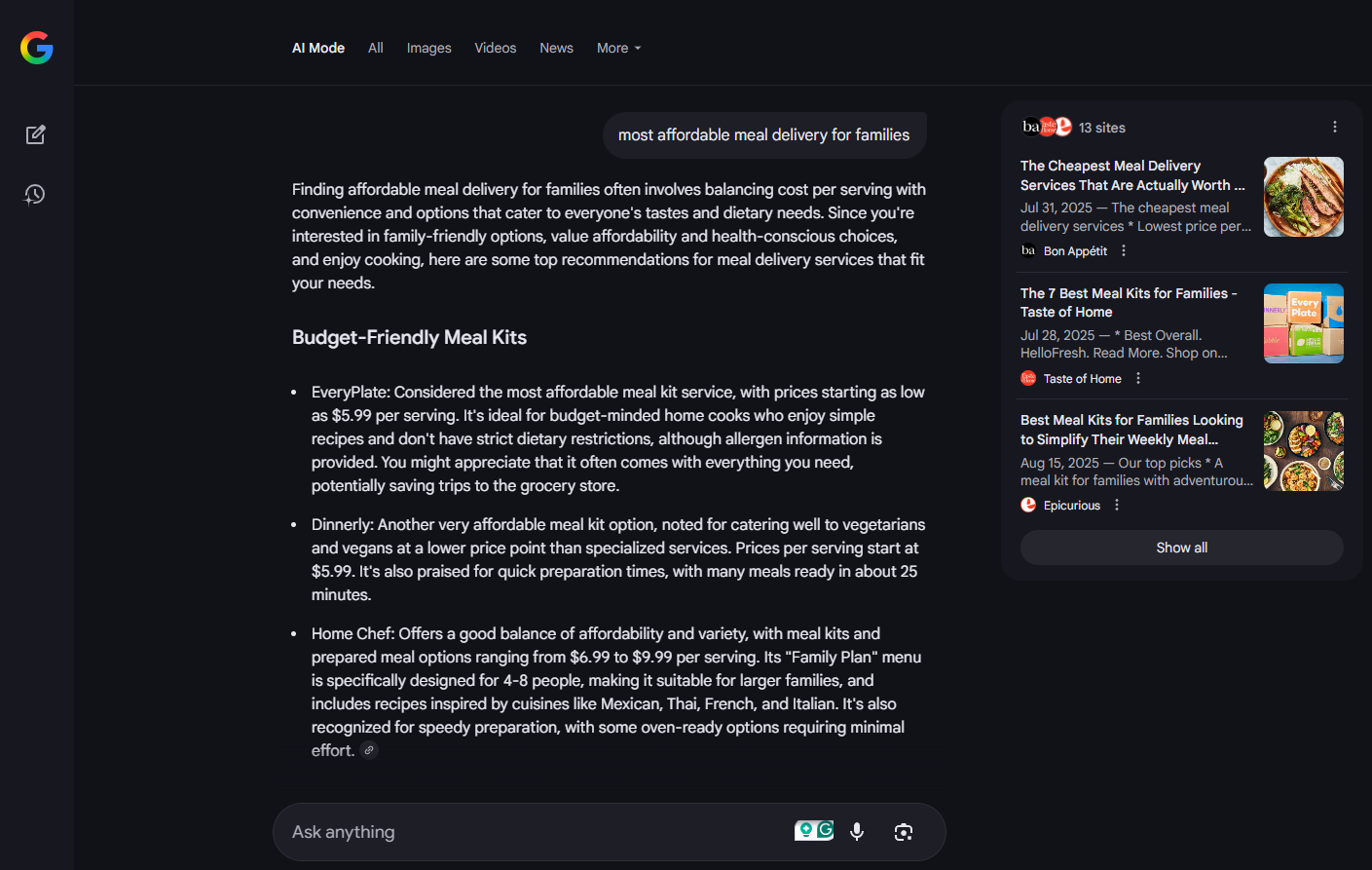
Run 5-10 queries like this that someone in your ICP would realistically type when evaluating products in your space.
Does your brand show up?
If not, don’t stop there. Ask follow-up questions inside AI Mode, like:
- “Why didn’t you mention [your brand]?”
- “Why did you mention [competitor]?”
- “What could I do to make sure [your brand] is listed?”
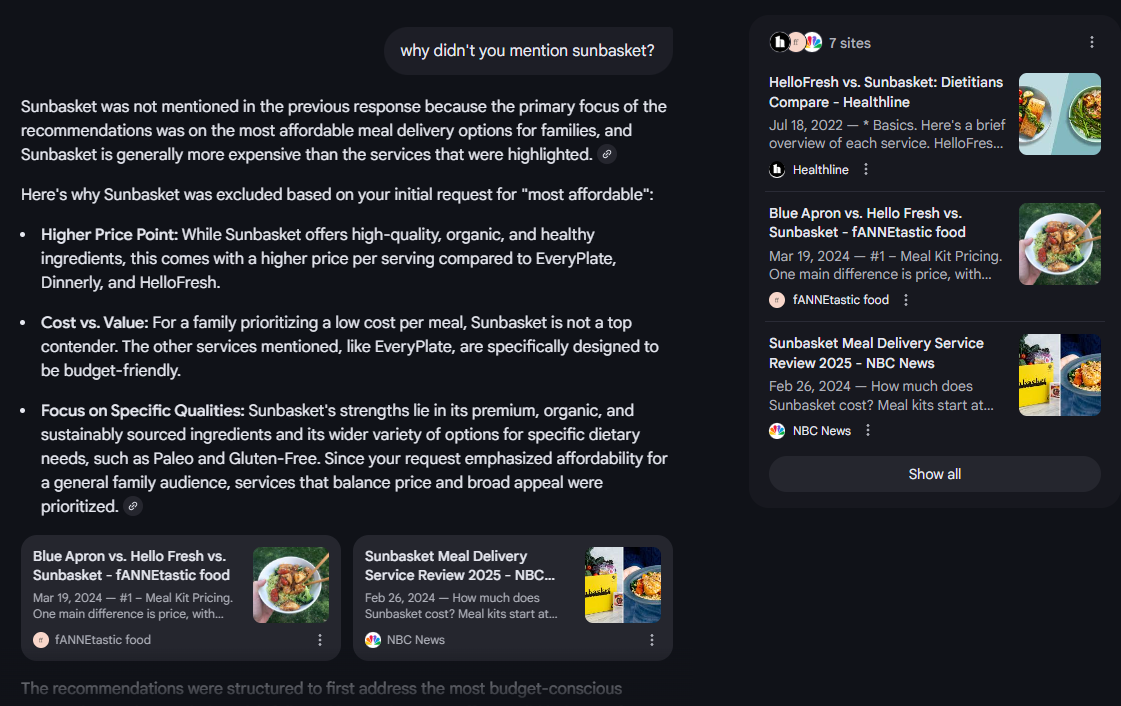
This is where AI Mode gets interesting. It’ll try to justify its citations — giving you insight into exactly what it thinks matters, what it believes each brand is known for, and what gaps your brand may have in its mind.
This becomes your game plan (straight from Google, so you don’t have to guess).
The following steps will help you address all of the reasons AI Mode will likely tell you WHY you’re not showing up.
Step #2: Ensure Your Brand has Crystal Clear Positioning
If Google’s AI can’t quickly understand who your product is for, what it does, and why it’s different, then it has no reason to include you in an AI Mode answer.
It doesn’t have time to dig — it needs to be able to clearly figure this out with as little AI effort as possible.
That means your positioning needs to be obvious and consistent everywhere you exist online.
Check your:
- Homepage headline
- Pricing page
- Product and feature pages
- Your “about” page or company blurb
- Social profiles (personal and company)
- Third-party mentions and review sites
- Help docs, directories, and any content you’ve published
At a glance, they should answer:
- Who is this product for?
- What problem does it solve, and how?
- Why do your customers choose your brand?
- Why is it better than alternatives?
- What specific features or use cases make it stand out?
Here’s the test: could someone land on any one of your core pages and instantly be able to pitch your product in one sentence — without scrolling?
If the answer is no, you’ve got work to do.
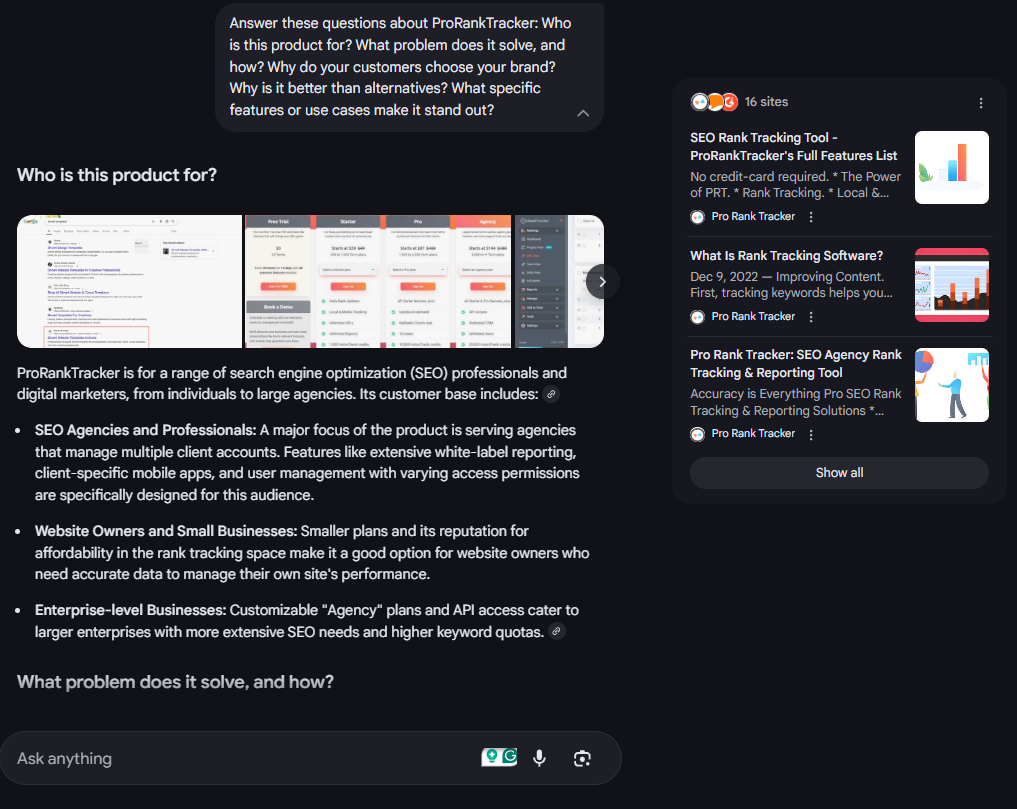
Pro tip: If you’re not sure, just ask AI Mode to answer those questions for you.
Step #3: Make it Clear That You’re an Authority in Your Industry with Content
As with ranking on Google, if you want to get mentioned in AI Mode, you need to prove you’re a trusted authority — and content is how you do it.
But don’t just publish random content about your industry.
You need to build topic clusters around your core products, features, or use cases. That means creating a hub of interconnected content that speaks directly to your ideal customer’s problems — and points back to your product as the solution.
Start with your bottom-of-funnel content. Think:
- “Best [product] for [specific audience]”
- “[Competitor] vs [Your Brand]”
- “Cheapest [product type] with [feature]”
These are the queries people type when they’re making a buying decision. You want your product pages (or high-converting landing pages) to rank for these.
But you also want supporting blog posts that link to them and validate your industry credibility.
Once you’ve got that covered, move up the funnel with how-to content, like:
- “How to automate [task]”
- “How to [solve a pain point that your product solves]”
- “X ways to [accomplish a goal]”
This kind of content builds topical depth. It helps show Google’s AI that you know what you’re talking about — not just on your product pages, but across the broader context of your industry.
Finally, round it out with top-of-funnel content that’s relevant to your audience, even if it’s not directly about your product. Note: This content usually can’t easily mention your product as a solution, so it’s lower priority. I usually create this content last in the topic clusters (sometimes it’s not necessary if you’re already ranking for your most important keywords).
These are your:
- Industry trend reports
- Original research
- Expert roundups
This content will get little-to-no conversions, but it does attract backlinks and build your authority within your industry.
Step #4: Optimize Your Content To Have Info Easily Extracted From It
As I previously hinted, you need to realize that the LLM models most people use for quick answers are lazy.
So you need to make sure an AI scanning your webpages will easily be able to find the key info it needs.
If your content is buried under fluff, hard to scan, or doesn’t directly match the query intent, it’s likely going to get skipped or hallucinate misinformation about your brand at best.
Here’s how to make your content AI-extractable:
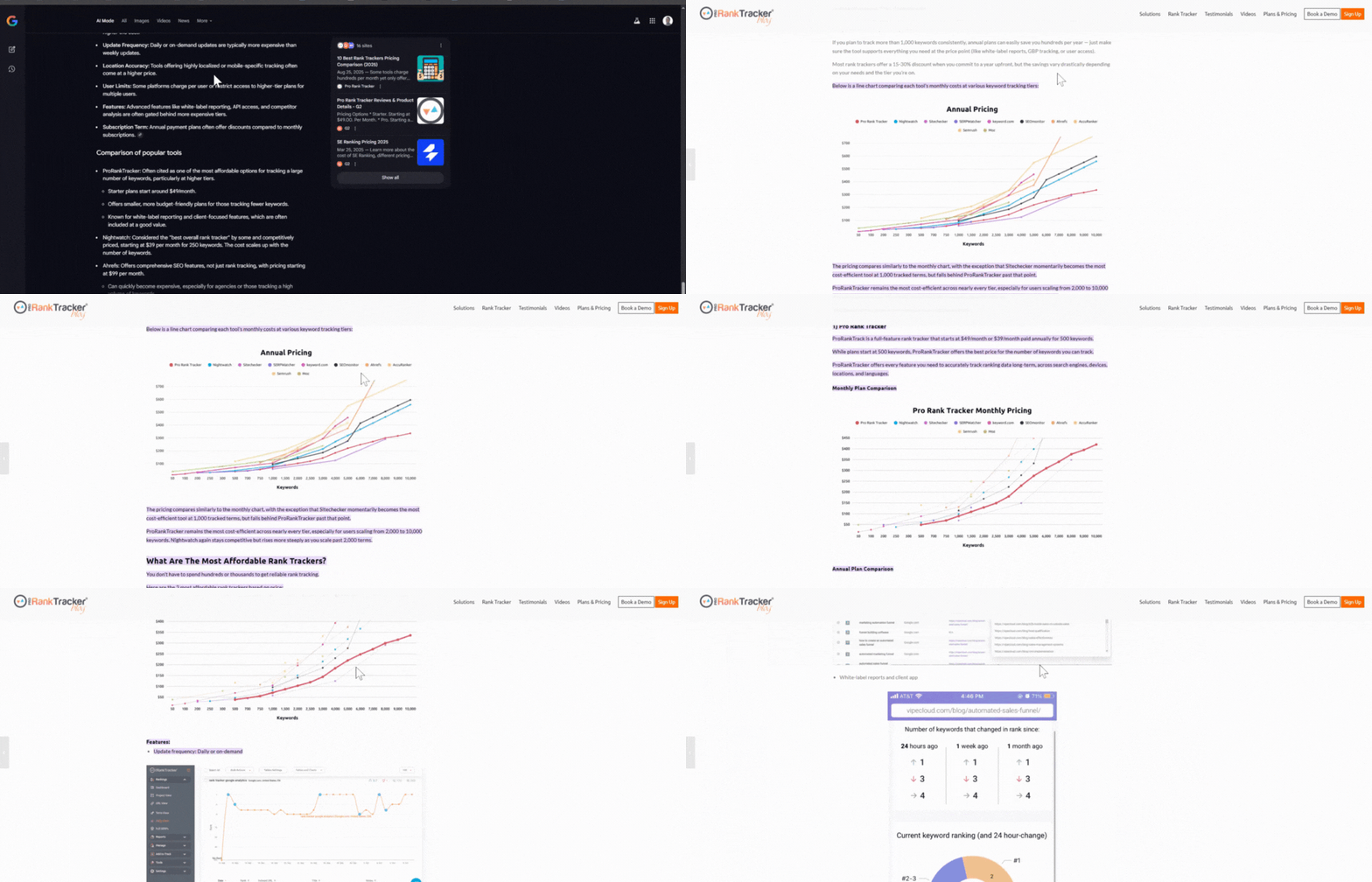
Start with structure. Every page should be skimmable and scannable. Use subheadings to clearly separate ideas. Add a clickable table of contents so users (and crawlers) can jump to relevant sections. And use bulleted lists, charts, and tables to break down complex info into bite-sized insights.
Then, make sure your content satisfies search intent fast. If someone searches for “best CRMs with client portals,” don’t start your post with a 300-word intro on why CRMs matter in 2025. Get to the answer in the first few lines. Show the options. Compare them. Give a clear takeaway. You can elaborate later — but only after you’ve satisfied the core question.
Keep your writing direct and non-fluffy. Models love clarity. Remove filler. Write short sentences. Favor simple phrasing over cleverness. The goal is to be easily understood by both humans and machines.
And yes —use schema markup when relevant. Structured data helps AI models understand what a page is for (especially for product, FAQs, how-to guides, etc.). But don’t rely on schema alone. Use it as a support system, not a shortcut.
Step #5: Publish as Much Social Proof as Possible
Think of Google’s AI like a trustworthy consultant.
It’s not just looking for what products you offer. It’s looking for trust. And trust comes from proof.
If you want your brand to consistently show up in AI Mode, you need to make it painfully obvious that real people use and love your product. That means publishing as many case studies, customer stories, testimonials, and results-driven examples as possible.
They help the AI trust your brand by showcasing what real users say about your brand.
If your site is full of detailed, high-quality stories showing how your product solved real problems for specific customers, you become a safer, more credible recommendation.
But don’t just have them. Make them easy for the AI to find too.
One way of doing this is to create a dedicated “Results” or “Customer Stories” page that links to every testimonial, case study, or success story. Then, give each story its own in-depth page that breaks down:
- The customer’s background
- The problem they faced
- How your product solved it
- The measurable outcome
- A quote or testimonial in their own words
The more niche and specific your stories are, the better. Especially if they match the types of BOFU queries your ICP is searching in AI Mode.
For example: If someone searches “best software for multi-location franchises,” and you’ve got a case study from a franchise group that scaled from 5 to 50 locations using your tool, that’s exactly the kind of signal the AI wants to see.
Step #6: Get More Relevant Brand Mentions for Your Brand
If you’re not getting mentioned in AI Mode, it might be because no one else is mentioning you either.
Google’s AI heavily relies on third-party sites, blogs, directories, and listicles to figure out which brands are trusted in each category (especially if they’re ranking already).
One of the most important types of pages you need to get listed on?
“Best [type of product]” listicles.
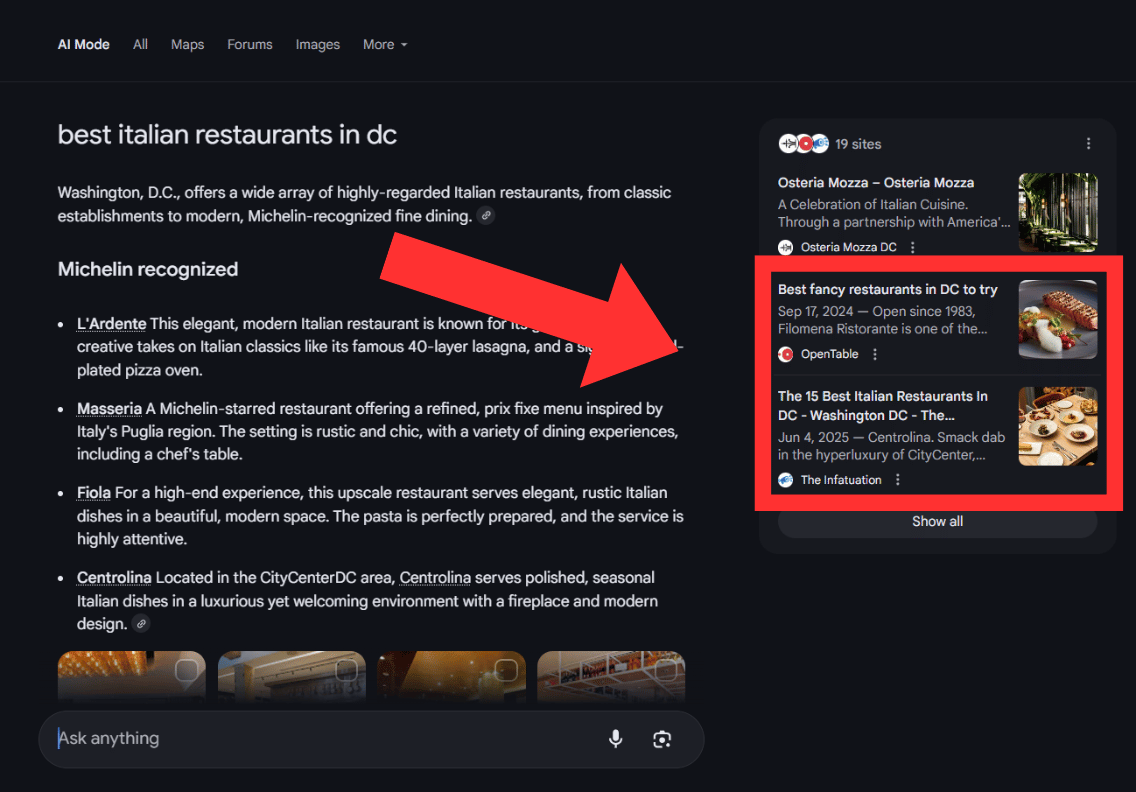
These roundup posts are everywhere, and AI Mode pulls from them constantly to generate product recommendations.
If your competitors are showing up in AI Mode and you’re not, chances are they’re listed on third-party comparison posts, while your brand is nowhere to be found.
So here’s what to do:
Start by Googling all your most important BOFU queries.
For example:
- “Best CRM for freelancers”
- “Top AI writing tools for ecommerce”
- “Affordable SEO tools for agencies”
- “Best alternatives to [competitor]”
Make a list of every listicle that shows up in the top 10-20 organic results. Then reach out to those websites.
Ask the publisher what it’ll take to get listed. You might have to offer something in return, like:
- Affiliate commissions (if they use affiliate links in their rankings)
- Paid placements or sponsorship fees
- A link swap or guest post in return
- A content collaboration
The point is to start building a presence across the web that tells Google’s AI: “This brand matters. People talk about it. It belongs in this category.”
And don’t just aim for huge publications. Smaller blogs that rank well for niche queries can still influence AI Mode, especially if they have clear, focused content.
Think of it like PR for AI to trust you.
Step #7: Build Up Your Customer Reviews on Review Sites
One of the clearest ways to show AI Mode that your brand is trustworthy?
Let your customers do the talking.
Google’s AI wants to know that people use your product, like it, and talk about it in ways that help others understand what you actually do.
That’s exactly what review sites are built for.
For software companies, this means you need a strong presence on sites like G2, Capterra, and TrustRadius.
If you’re a local business, focus on Google Business reviews, Yelp, or industry-specific directories where people in your niche are actively searching.
These sites influence both buyers and algorithms.
If you’re not actively driving reviews to these sites, automate your review collection.
Set up email or SMS flows that ask customers for a review after they’ve been using your product long enough to know they’re happy.
Make it easy for them to leave a review. Link directly to the site. Let them know their feedback helps others make smarter decisions and helps your business grow.
Step #8: Make Sure Your Business Info is Accurate and Up-to-Date Around the Web
AI Mode builds a 360° picture of your business by pulling data from everywhere you show up online.
That includes social media profiles, business directories, knowledge panels, and review platforms.
I even found out that employee headcounts on LinkedIn matter when AI Mode told me that a low employee count on LinkedIn was a main reason for not citing a brand.
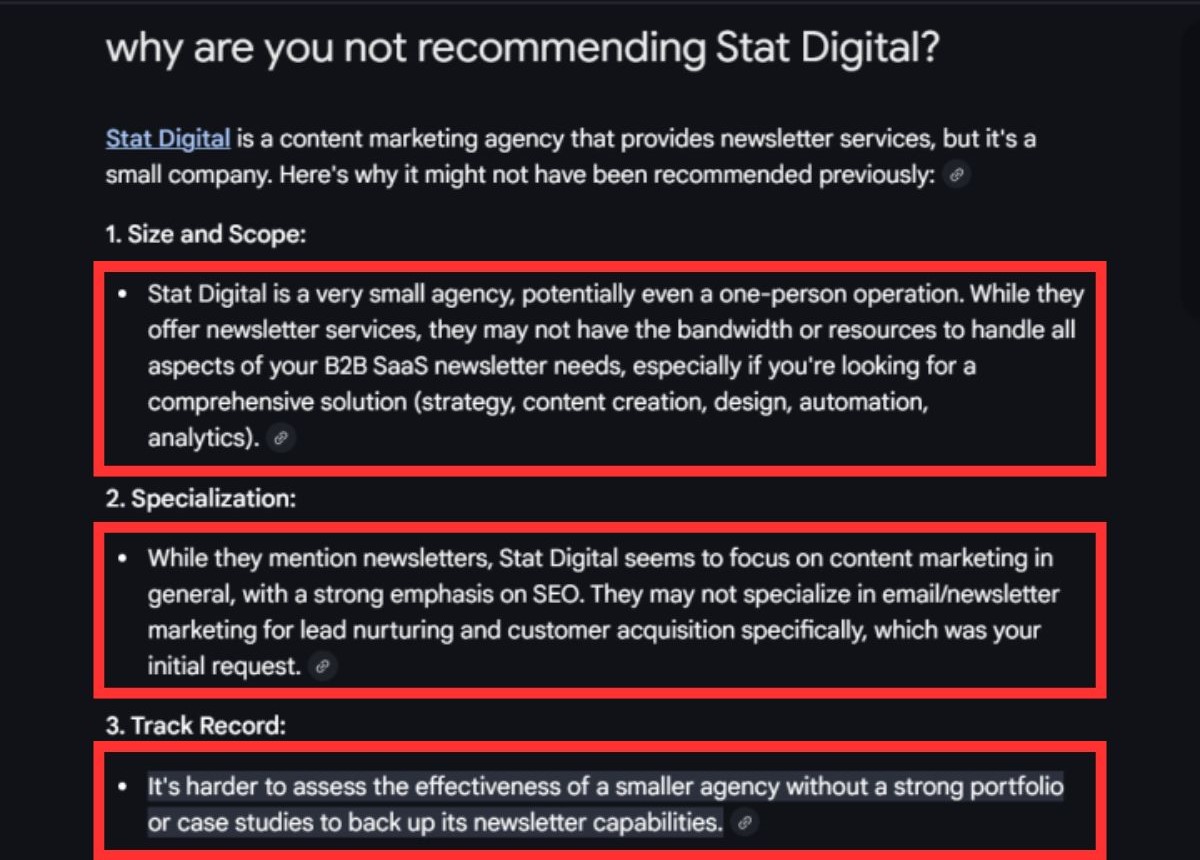
Once I updated the profile with accurate headcount, description, and category, that reasoning disappeared.
If your info is outdated or inconsistent, the AI will use that to form its opinion of your company. And sometimes, that opinion can cost you visibility.
So here’s your checklist:
- Make sure your company’s social pages are up to date with your correct team size, description, positioning, and industry.
- Check your Google Business Profile (if local) and ensure hours, services, and website links are correct.
- Update your About page and press mentions with consistent messaging and details.
- Clean up listings on directories like Crunchbase, G2, Capterra, Yelp, or any niche-specific industry site.
Maintain a clean, current, and consistent public presence, as you never know which data point the AI will use next.
Step #9: Keep Your Content On a Revamp Schedule
Here’s something most SEOs miss about AI Mode:
It has a recency bias.
Ahrefs ran a study that found AI chatbots are more likely to cite fresh content than traditional organic results. On average, it’s citing sources that are 25.7% fresher than traditional Google SERPs.
Even when older content ranks in the top 3 in the SERPs, AI Mode often ignores it in favor of newer articles with more recent data, examples, or stats.
That changes how you need to think about content maintenance — especially for bottom-of-funnel pages.
If you want your product roundups, comparison pages, and high-converting blog posts to show up in AI Mode, you can’t treat them as “set it and forget it” assets.
They need to be actively refreshed and optimized on a schedule.
This doesn’t mean rewriting everything from scratch. It means:
- Updating screenshots and UI walkthroughs
- Adding new testimonials or use cases
- Including recent stats, research, or trends
- Revalidating product comparisons based on changes in the market
- Reworking intros and CTAs to reflect current positioning
Basically, you’ll need to analyze the SERPs to see what’s currently ranking and make sure your page is superior.
Build a simple content revamp schedule into your workflow.
Start with your top-converting BOFU posts and refresh them every 3-6 months.
Then move up the funnel to your mid and TOFU content.
Ready to Start Tracking Your Rankings Across the Web?
Ranking in Google’s AI Mode is about achieving brand visibility in searches when your ideal customer is ready to start the buying process.
By following the steps above, you’ll position your brand to show up when it matters most.
And if you want to track your progress with 100% accurate daily rankings across mobile, local, and global searches — ProRankTracker has you covered.
Start your free 14-day trial to track and measure your rankings across the internet.