
7 Best AI Rank Trackers (Reviewed 2026)
Your customers are now scrolling less on Google and are instead getting direct answers from AI Overviews, AI Mode, ChatGPT, or another AI platform.
That means you can rank number one in traditional search and still be missing from the AI-generated answers that are now influencing purchase decisions.
It’s time to face the facts:
People click a traditional search result on just 8% of searches that display an AI summary, compared with 15% when no summary appears.
But you can’t improve AI visibility if you don’t know where your brand appears.
AI answers change by platform, prompt, location, and day. Manually checking a few questions won’t show whether your visibility is improving, which pages are getting cited, or where competitors are taking your place.
That’s why you need an AI rank tracker to monitor your mentions and citations over time, so you can measure what’s working instead of relying on occasional spot checks.
The problem is that these tools vary widely. Some update daily; others weekly. Some track both brand mentions and cited links, while others only show part of the picture. And a cheap starting price can climb quickly once you add more prompts, platforms, or reports.
So, I evaluated 7 of the leading AI rank trackers and ranked them by what each one does best.
My Top Picks for the Best AI Rank Trackers
| Tool | Best For | AI Platforms Tracked | Starting Price |
| ProRankTracker | AI + organic in one accurate tracker | AI Overviews, AI Mode, ChatGPT, Gemini, Perplexity, Copilot | $99/mo (500 prompts) |
| SE Ranking | All-in-one SEO suite with AI built in | AI Overviews, AI Mode, ChatGPT, Gemini, Perplexity | $129/mo (100 prompts) |
| Otterly.ai | Budget AI monitoring for small teams | ChatGPT, AI Overviews, Perplexity, Copilot (+ add-ons) | $29/mo (15 prompts) |
| Semrush | Teams already living in Semrush | ChatGPT, AI Mode, Perplexity, Gemini | $99/mo (25 prompts) |
| Ahrefs | Citation depth and real-prompt data | AI Overviews, AI Mode, ChatGPT, Perplexity, Copilot, Gemini | $50/mo (83 prompts) |
| Profound | Enterprise AI visibility and demand data | ChatGPT to 10 engines by tier | $99/mo (50 prompts) |
| Local Falcon | Local and map-based AI visibility | ChatGPT, AI Overviews, Gemini, AI Mode, Grok | $24.99/mo (7,500 credits) |
Every price here came from the vendor’s own website and is as up-to-date as this article’s publish date.
How I Evaluated These Tools
Not every tool that offers “AI tracking” gives you the same data. So I ranked each one on what it can track, how often it updates, how clearly it shows your visibility, how easily you can report the results, and what it actually costs at the volume you need.
- AI platform coverage – Which AI engines the tool tracks (not just how many), from AI Overviews and AI Mode to ChatGPT, Gemini, Perplexity, Copilot, and Claude
- Accuracy and update frequency – How often the tool refreshes its data, since AI answers can change from one day to the next
- Links and mentions – Whether it tracks both Mentions (your brand named in the answer) and Links (cited and ranked URLs), or only one
- Organic rank tracking – Whether you can monitor your traditional Google rankings and AI visibility in the same tool, report, and workflow
- Competitor tracking – Whether it shows which competitors appear for your prompts, where they outrank you, and which sources help them get cited
- Prompt discovery – Whether it suggests relevant prompts, provides real-prompt data, or offers research tools that help you choose what to track instead of wasting your quota on guesses
- Location and language tracking – Whether it can monitor the countries, regions, and languages where your customers actually search
- Reporting – How easily you can create white-label reports, automate delivery, export your data, and share results with clients or teammates
- Integrations – Whether you can connect the data to Looker Studio, internal dashboards, or other tools through an API
- The real price – What you’ll actually pay after prompt limits, platform add-ons, extra domains, users, reports, and required base subscriptions
- Support – Whether you can reach a real person when results look wrong or you need help setting up your tracking correctly
For each tool, I give my personal feedback as an SEO and content marketer who works with clients, and has used AI rank trackers for the past 6+ months. That experience helped me separate features that sound impressive on a pricing page from the tracking data, reporting options, and workflows that are actually useful.
I also include feedback gathered from reviews on each tool from the past year.
1. Best Dedicated AI Rank Tracker: ProRankTracker
ProRankTracker has specialized in accurate Google rank tracking for more than a decade. Now, it brings that same daily tracking into AI search, so you can monitor your organic rankings and AI visibility in one place.
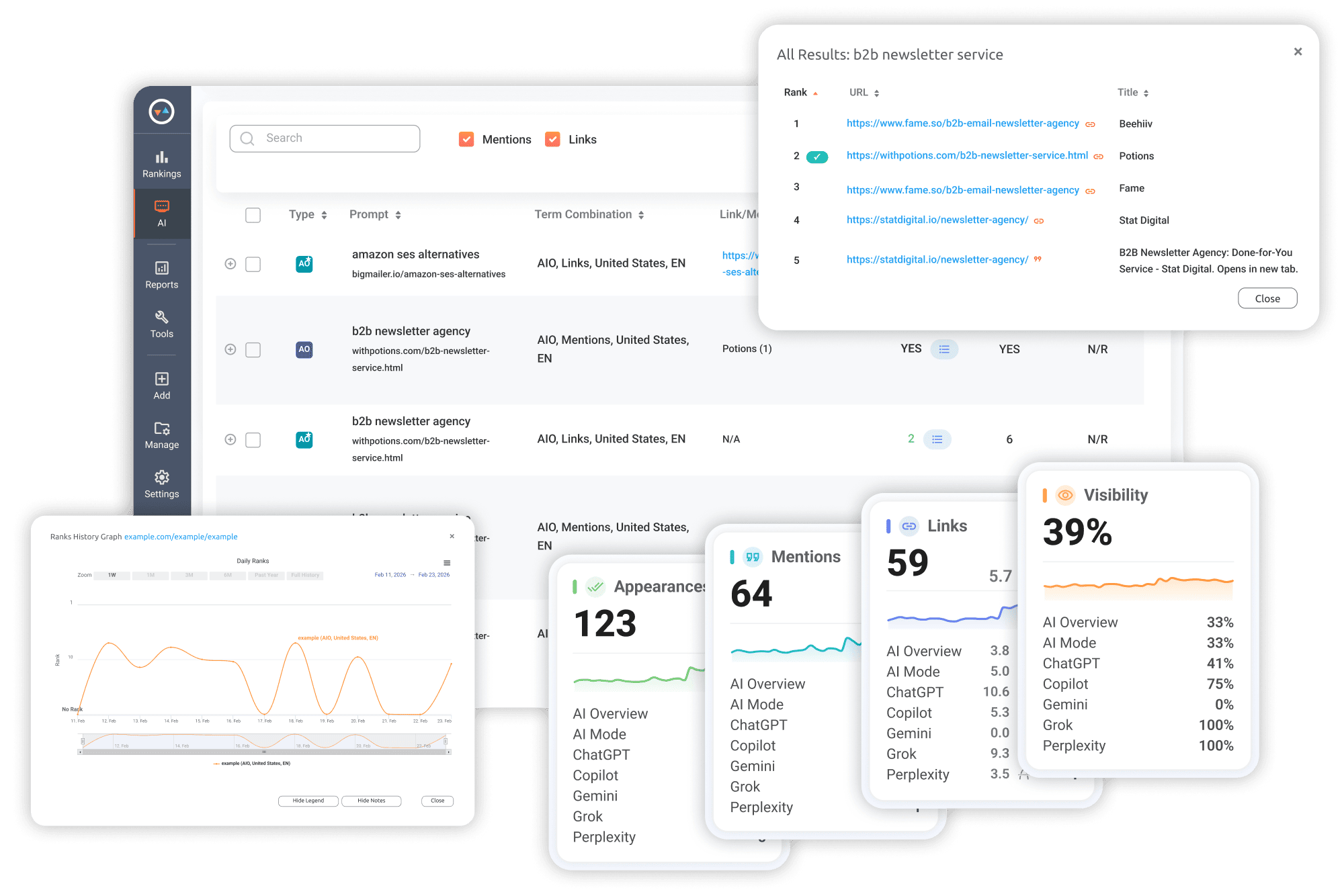
It tracks 2 types of visibility across AI Overviews, AI Mode, ChatGPT, Gemini, Perplexity, and Copilot:
- Mentions – Find where AI answers name your brand and see the surrounding sentence
- Links – Track which URLs get cited, where they rank in the answer, and how often they appear
That matters because a brand mention and a cited page tell you different things. ProRankTracker tracks both beside your organic rankings, making it easier to see where you’re gaining visibility and where competitors are taking your place.
ProRankTracker isn’t an all-in-one SEO suite, so you won’t get the backlink and site-audit tools included with platforms like Semrush or Ahrefs. But if your priority is accurate daily tracking, generous prompt limits, and reports you can hand directly to clients, it’s the strongest overall option on this list.
Pros
- Track AI, organic, local, and video rankings in one platform
- Get daily visibility updates across all 6 supported AI platforms
- Monitor both brand Mentions and cited Links, including rank and count per prompt
- Access all 6 AI platforms on every plan without per-platform add-ons
- Compare competitor citations inside the same AI answers
- Create scheduled, customizable white-label reports for clients
- Track unlimited URLs and projects
Cons
- There’s no free plan, just a free trial
- It’s not an all-in-one SEO tool, although it comes with extra tools (like Prompt Suggestions, Rankings Discovery, and AI Competitor Comparisons)
Features
- AI Visibility Tracking – Track your presence across AI Overviews, AI Mode, ChatGPT, Gemini, Perplexity, and Copilot
- AI Mentions Tracking – Find where AI answers mention your brand, with sentence context and mention counts for each prompt
- AI Links Tracking – Track every cited URL, including its position and total number of appearances in each answer
- Competitor AI Visibility – See where competitors earn citations inside the same AI answers and find gaps in your own visibility
- Daily AI and Organic Updates – Refresh your AI visibility and traditional rankings every day, with on-demand organic updates on eligible plans
- AI Prompt Discovery – Find new prompts to track with Prompt Suggestions, Rankings Discovery, and Competitor Comparison tools
- Organic, Local, and Video Rank Tracking – Monitor top-100 Google rankings, mobile results, Google Business Profile listings, and YouTube rankings
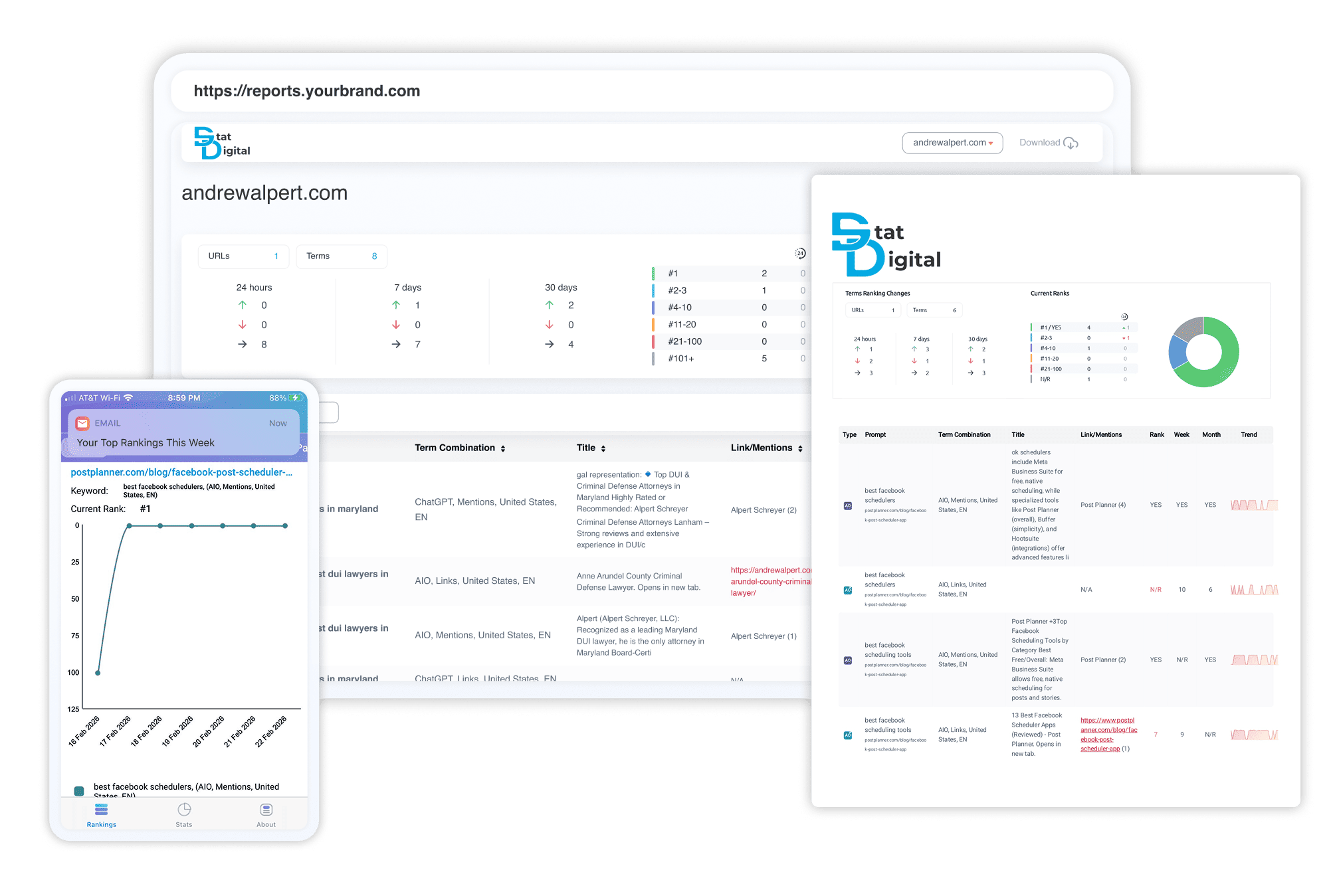
- White-Label Reporting – Create scheduled, shareable reports with your branding in PDF, XLSX, CSV, email, or live-report formats
- Mobile and Client Apps – Check rankings through the PRT mobile app and give clients branded access through MyRanks
- Integrations and API – Send ranking and AI visibility data to Looker Studio, Google Sheets, cloud storage, or your own systems through the API
- Team and Support Tools – Add users with custom permissions and get live chat, 24/7 ticket support, training, and a dedicated CSM on agency plan
Pricing
ProRankTracker offers a 7-day free trial to track 50 prompts with all premium features. Each plan includes AI tracking and is based on how many prompt combinations you track. One combination = one prompt + one URL + one platform.
Here’s how they break down:
- Starter – $99/month (or $89/month billed annually) for 500 prompts
- Pro – $149/month (or $134/month billed annually) for 1,000 prompts and 10 users
- Agency – Starts at $199/month (or $179/month billed annually) for 1,500 prompts, with API access and unlimited users
Annual billing takes 10% off.
Reviews
ProRankTracker earns a strong 4.6 on G2, where users highlight its accuracy, the daily email updates, and how fast it is to set up.
A few reviewers note a learning curve at the start, but there’s an expert support team available for those who need any help.
Here’s what Bryan R. had to say about using ProRankTracker:
“Pro Rank Tracker has been an invaluable tool for tracking our local Google rankings. It’s incredibly user-friendly, making it easy to add new keywords and URLs to monitor. The insights provided are detailed and accurate, which has significantly helped us optimize our SEO strategies.”
2. Best All-in-One SEO Suite with AI: SE Ranking
SE Ranking is a strong option if you want AI visibility tracking inside a broader SEO platform. One subscription covers keyword research, site audits, backlink analysis, traditional rank tracking, competitor research, and AI tracking across Google AI Overviews, AI Mode, ChatGPT, Gemini, and Perplexity.
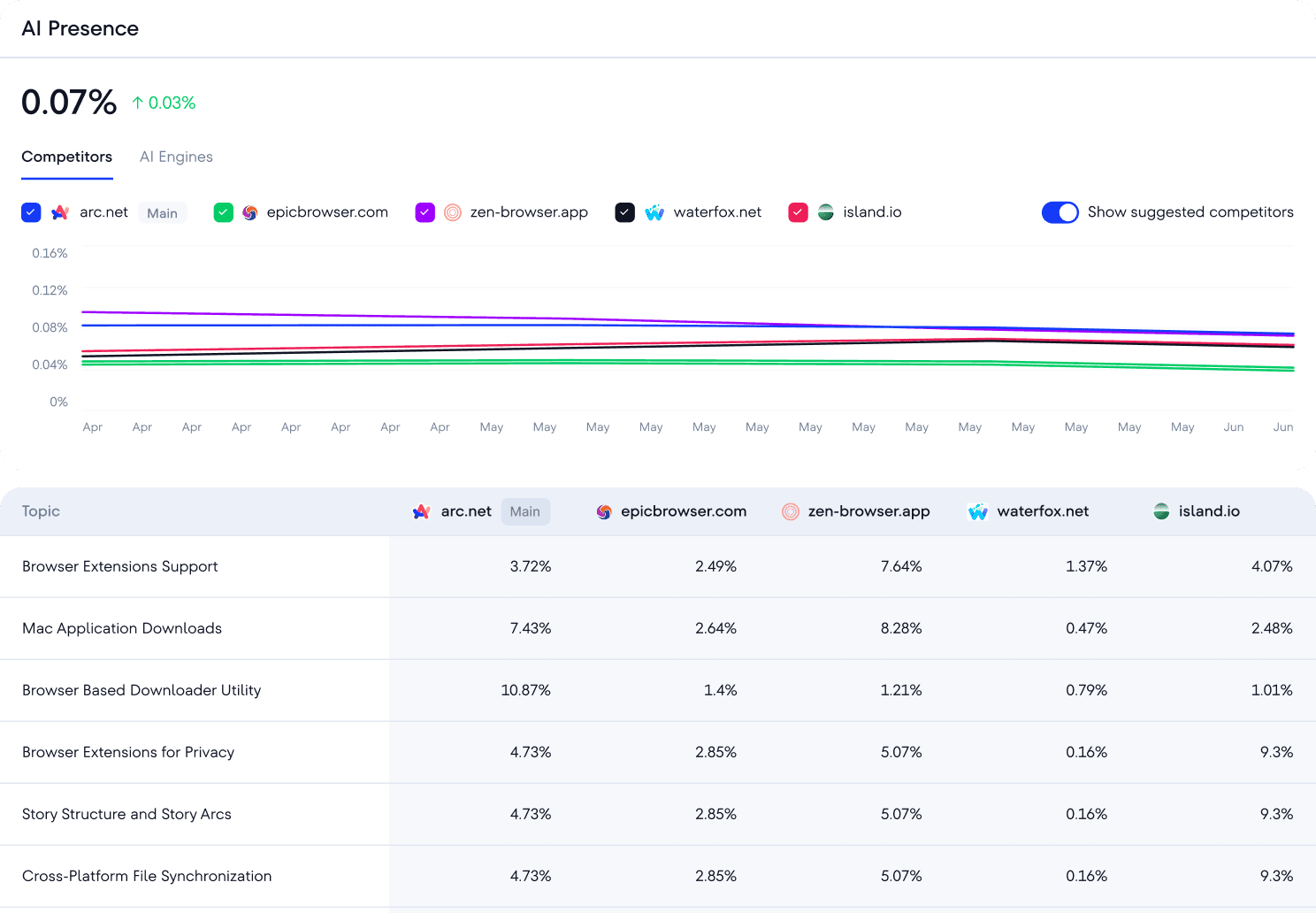
Its Core plan starts at $129/month and includes 100 tracked AI prompts. That may be enough for an in-house team monitoring one brand, but agencies and larger sites can outgrow the limit quickly.
The extra costs are where you need to pay attention. White-labeling and unlimited reports require the Agency Pack, which costs another $828 per year. Adding 1,000 more AI prompts costs $345 per month, which is several times more than tracking the same volume with a dedicated tool like ProRankTracker.
I’d recommend SE Ranking to businesses that want one platform for most of their SEO work and only need to track a modest number of AI prompts. But if AI visibility is a major service or you manage multiple clients, the prompt limits and add-ons can make it much more expensive than it first appears.
Pros
- Strong value compared to Semrush and Ahrefs
- Clean interface with easy report automation
- Responsive support that ships features fast
- Solid rank tracking, competitor analysis, and site audits
- AI tracking bundled into the core plans
Cons
- Prices have drastically increased in the past year
- No Copilot coverage
- The rate you pay for tracking prompts is 2-3x more than a dedicated AI rank tracker
- There’s a lot of other limits you have to pay attention to: projects, reports, historical data, AI competitors, etc.
Features
- AI Results Tracker – Monitors your brand’s mentions and links across the 5 AI engines
- AI Competitor Research – Measures any brand’s AI presence across engines
- AI Source and Coverage Analysis – Maps the domains and URLs that appear in AI answers
- Keyword rank tracking – Daily positions with local and device options
- Keyword research and competitor analysis – Full traditional SEO research tools
- Site audit – Flags technical SEO issues to fix
- API and MCP access – Pulls your AI and rank data into Looker Studio or Claude
Pricing
SE Ranking bundles AI tracking into its core plans and charges by how many keywords and AI prompts you track. Here’s how it breaks down:
- Core – $129/month (or $103.20/month billed annually) for 2,000 keywords a day and 100 AI prompts a day across 5 LLMs
- Growth – $279/month (or $223.20/month billed annually) for 5,000 keywords and 250 AI prompts a day
- Enterprise – Custom pricing
They offer a 14-day free trial. Deeper AI reporting (white-label and unlimited reports) is available through the Agency Pack add-on for an additional $828/year.
Reviews
SE Ranking earns a 4.7 on G2, where users highlight its pricing relative to Semrush and Ahrefs, the all-in-one feature set, and how quickly the team ships new features.
Complaints are that the prices have drastically increased over the years.
Here’s what Mario C. had to say about using SE Ranking:
“AI Citation Analysis has been particularly valuable during competitor research and content audits. We regularly review which publishers, websites, and sources AI engines reference for industry-specific prompts.”
3. Best for Low Volume: Otterly.ai
Otterly.ai is an AI visibility tracker that monitors your brand across AI answers and runs GEO audits to check how ready your content is to get cited.
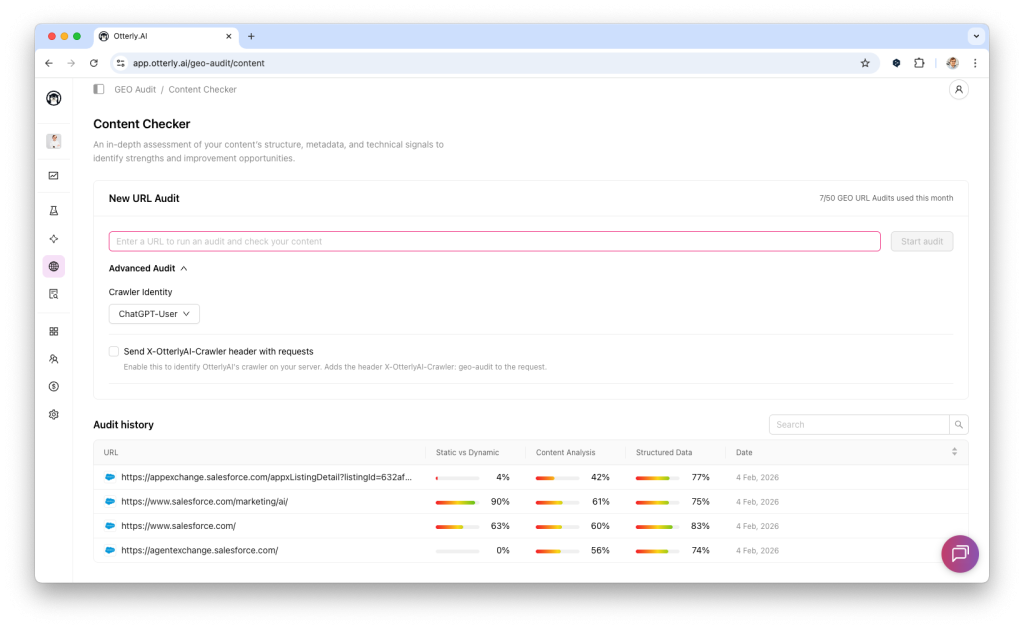
It offers one of the cheapest entry points at $29/month. But the catch is this plan only allows you to track 15 prompts, and you’ll likely need to purchase more add-ons to fully track your AI visibility.
It covers 4 AI engines on its base plans: ChatGPT, AI Overviews, Perplexity, and Copilot. If you want AI Mode, Gemini, or Claude, those are paid add-ons on top of your plan.
For solo marketers and small teams that just want to see where they show up across AI platforms for a few prompts without committing to a full-scale tool, it’s a solid starting point. For agencies managing multiple clients, this tool is far from being economical.
Pros
- Low $29 entry price
- Intuitive, quick-to-learn interface
- Responsive support and onboarding
- Unlimited team members on every plan
- GEO audits included
Cons
- Only 4 AI platforms on the base plans, with the rest as paid add-ons
- The jump to the $189 Standard plan is steep for a small team
- The cost to increase your prompt limit is expensive at almost ~$1 per prompt paid monthly.
Features
- AI Prompt Research – Find the prompts your audience is asking across AI search
- AI Search Analytics – Track your brand and website visibility across major AI engines
- Competitive Benchmarking – Compare your mentions, coverage, and citations against competitors
- Brand Sentiment Analysis – Analyze how AI perceives your brand
- Domain Citation Tracking – Tracks every domain and URL cited in AI answers, with weekly link-position changes
- Brand Visibility Index – Score your brand’s visibility across AI platforms over time
- Content Audit – Score a page’s structured data and AI-readiness, and get specific improvement recommendations
- Recommendations – Turn report data into prioritized next actions
- Multi-Country Tracking – Monitor visibility across 65+ countries and languages
- Integrations – CSV exports, Looker Studio connector, MCP server, and API
Pricing
Every plan includes unlimited team members. Here’s how many prompts you can track with each plan before add-ons:
- Lite – $29/month (or $25/month billed annually) for 15 prompts
- Standard – $189/month (or $160/month billed annually) for 100 prompts
- Premium – $489/month (or $422/month billed annually) for 400 prompts
Annual billing saves 15%. AI Mode, Gemini, and Claude are paid add-ons on top.
Reviews
Otterly earns a 4.8 on G2 across 52 reviews. Users like how fast it delivers useful data and the responsive support. The common complaint is that costs climb once you add more AI platforms and prompts.
Here’s what a verified user had to say about using Otterly:
“OtterlyAI has been a great tool. The UI is very intuitive, and it helps me quickly understand which prompts are working well for my organization and which ones aren’t. Being able to see the exact prompt response for each one is a game changer, especially since it lets me view things the way my customers would.”
4. Best for Enterprise Teams: Semrush
If your SEO team already runs on Semrush, adding AI tracking is an easy way to keep more of your data under one roof.
Its AI Visibility Toolkit tracks your brand across ChatGPT, Google AI Mode, Perplexity, and Gemini (with Grok and Claude available on the Enterprise plan). That puts AI visibility alongside the keyword research, backlink analysis, site audits, and competitive research many larger teams already use Semrush for.
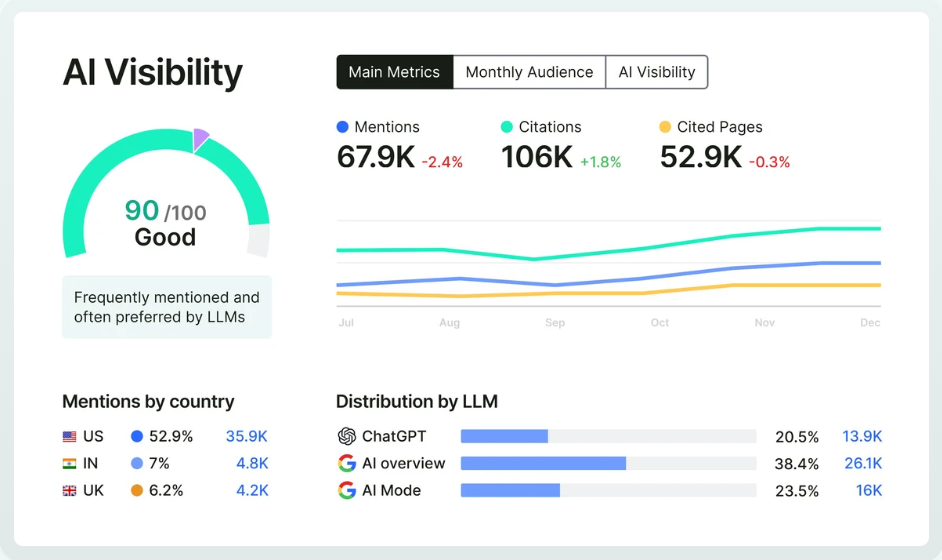
The catch? AI tracking gets expensive as your needs grow.
You can buy the AI Visibility Toolkit on its own for $99/month, but that only includes 25 tracked prompts and one domain. Your costs can climb as you add more prompts, domains, users, or reporting needs.
That makes Semrush most appealing when AI tracking is just one tool you’ll need as part of an enterprise-level all-in-one SEO tool.
But if AI rank tracking is your main priority, the limits are harder to justify. Solo marketers, smaller teams, and agencies tracking lots of prompts may get more tracking capacity for their money with a specialized AI rank tracker.
Pros
- Keeps AI tracking inside the Semrush ecosystem
- Strong keyword, backlink, audit, and competitive research tools
- Useful for enterprise teams that want to consolidate their SEO data
- Extensive training and educational resources
- Includes prompt tracking and AI-focused site auditing
Cons
- Gets expensive as you add more prompts, domains, users, or reporting needs
- Standalone AI toolkit only includes 25 tracked prompts and one domain
- No free trial for the AI Visibility Toolkit
- Can be overkill for small teams that only need AI rank tracking
Features
- Visibility Overview – Benchmark your brand’s AI visibility globally or by region with an overall AI Visibility Score
- Prompt Tracking – Track day-by-day visibility changes for specific prompts in Google AI Mode and ChatGPT
- Brand Performance – Analyze your share of voice, sentiment, and the narratives AI platforms associate with your brand
- Competitor Research – Compare your AI presence against competitors and find where they earn mentions and citations that you don’t
- Prompt Research – Discover relevant AI prompts and evaluate them with topic-level volume, difficulty, and intent data
- AI Search Site Audit – Identify technical issues that may prevent AI crawlers from accessing and understanding your content
Pricing
There are 2 ways to get AI tracking: subscribe to the AI Visibility Toolkit on its own, or get it bundled into a SEO + AI Search plan. Here’s how it breaks down:
- AI Visibility Toolkit – $99/month (billed annually) for 25 tracked prompts and 1 domain, bought on its own
- SEO and AI Search plans – $139 to $549/month (or $117 to $456/month billed annually), with the pricier tiers including AI Visibility
The toolkit has no free trial. Extra prompts, domains, and users each cost more.
Reviews
Semrush earns a 4.4 on G2 across more than 4,000+ reviews, where users praise its all-in-one depth and its data.
The most common complaints center around its price and steep learning curve.
Here’s what Sofia B. had to say about using Semrush:
“I like that it integrates with Google Analytics 4 and Google Search Console, giving me a comprehensive dashboard based on real data. As an SEO manager, I really appreciate being able to track my website’s performance in one place, without having to rely on clunky, DIY integrations across different tools and platforms.”
5. Best for Real Prompt Data: Ahrefs
Ahrefs’ biggest advantage is Brand Radar, which analyzes more than 403 million real monthly prompts. That lets you research what people are actually asking AI platforms instead of building your tracking strategy entirely around internal assumptions.
You can analyze visibility and cited sources across AI Overviews, AI Mode, ChatGPT, Perplexity, Copilot, and Gemini. This is especially useful when you want to find which topics generate AI demand, which competitors dominate those answers, and which websites AI platforms cite.
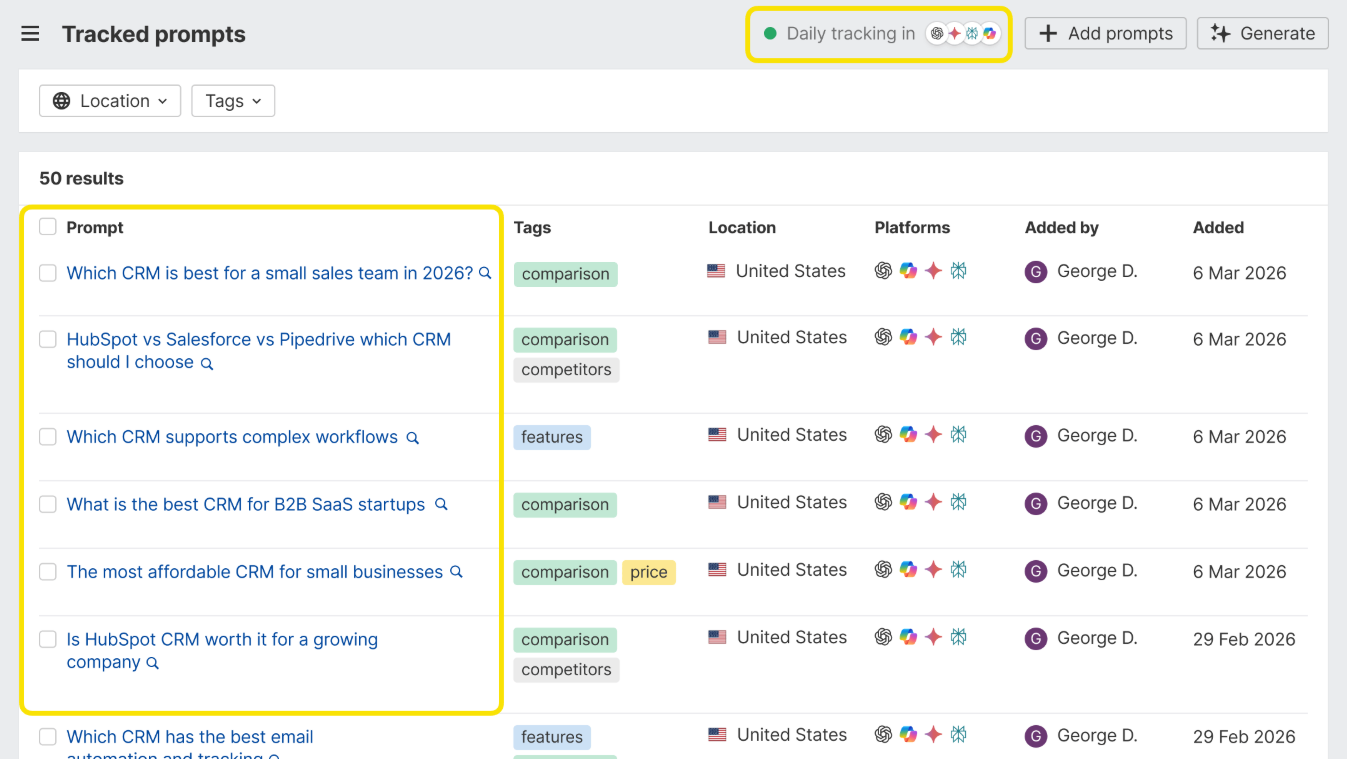
Ahrefs also offers a separate Custom Prompts product for tracking questions you choose yourself. That starts at $50/month on a free Ahrefs account, so you don’t need a full Ahrefs subscription or Brand Radar just to monitor your own prompts.
The price climbs when you want the full Brand Radar database and broader platform coverage. Prompt research starts at $199/month, while complete platform access costs as much as $699/month.
I’d recommend Ahrefs most to teams that want real-prompt and citation research, instead of just basic visibility monitoring. The $50 Custom Prompts package makes simple tracking more accessible, but Brand Radar’s unique value is helping you discover what people ask and which sources influence the answers. As a former Ahrefs user, I’d still watch the usage limits closely, since the cost can rise quickly as your research and tracking needs expand.
Pros
- Uses a massive database of real prompts instead of relying only on manually tracked queries
- Combines AI citation analysis with Ahrefs’ extensive backlink and search data
- Clean, visual interface that makes large datasets easier to analyze
- Offers extensive free training and education through Ahrefs Academy
- Tracks cited sources across platforms like YouTube, TikTok, and Reddit
Cons
- Gets expensive for small businesses or teams tracking lots of prompts
- Some reviewers report slow customer support
Features
- AI Brand Mention Tracking – Track how often your brand appears across AI answers and where those mentions show up
- Competitor Benchmarking – Compare your AI visibility against competitors and identify the brands dominating your space
- AI Citation Finder – Find the sources AI platforms cite for your topics and uncover new citation opportunities
- Real-Prompt Database – Research 403M+ real monthly prompts backed by actual search behavior instead of synthetic queries
- AI Source Tracking – Analyze the YouTube, TikTok, and Reddit sources contributing to AI visibility
- Custom Prompts – Add your own questions to track exactly how your brand appears for the prompts you care about
- Unlimited Projects – Analyze the AI visibility of any domain without setting up separate projects
Pricing
Ahrefs splits its AI tracking into 2 separate products: Custom Prompts for monitoring prompts you choose and Brand Radar for researching Ahrefs’ database of real prompts across AI platforms.
Use Custom Prompts when you already know which questions you want to monitor.
- Ahrefs Lite – $129/month ($108/month billed annually), including 5 prompts checked daily, or 150 checks per month
- Basic package – $50/month for 2,500 additional checks, enough for roughly 80 prompts checked daily on one platform
- Growth package – $100/month for 7,000 additional checks
- Scale package – $250/month for 25,000 additional checks
You can add a Custom Prompts package to either a free or paid Ahrefs account, so you don’t need Brand Radar just to track your own prompts.
Brand Radar is Ahrefs’ higher-priced research product. It gives you access to its real-prompt database and broader AI platform analysis, and it comes with a free Ahrefs account.
- Brand Radar entry – From $199/month for access to the prompt database
- Select platforms – $398/month for individual AI platform datasets
- All platforms – $699/month for full platform coverage plus 2,500 Custom Prompt checks
If you only need to monitor a small set of prompts, you can start with a $50/month Custom Prompts package. Brand Radar costs more because it adds real-prompt research and large-scale, multi-platform visibility data.
Reviews
Ahrefs earns a 4.5 on G2 and a 4.7 on Capterra, where users rate its data quality highly.
The most common complaints center around its high price and extra costs tied to usage limits and add-ons.
Here’s what Bhavishya J. had to say about using Ahrefs:
“Ahrefs has the most comprehensive backlink database I’ve used. The Site Explorer gives deep insights into competitors’ link profiles, organic keywords, and traffic estimations. This is an easy to use tool.”
6. Best for AI Demand Data: Profound
Profound helps you figure out which prompts actually matter for your business.
Its standout feature is Prompt Volumes, which estimates AI search demand using data from more than 1.5 billion real AI conversations. Instead of relying entirely on your own assumptions about what customers ask ChatGPT and other AI platforms, you can find higher-demand topics and build your tracking strategy around them.
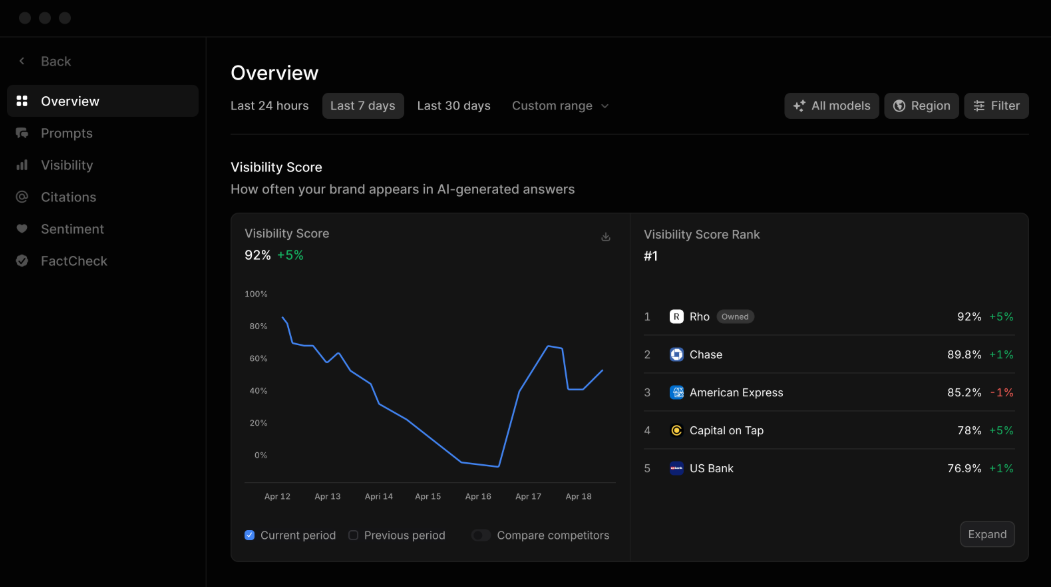
Profound also goes beyond basic visibility tracking with tools for monitoring citations, brand sentiment, inaccurate AI claims, AI crawler activity, and traffic from AI platforms.
The downside is the $99/month Starter plan only tracks ChatGPT, while multi-engine tracking starts at $399/month. I’d recommend Profound most to larger brands that want AI demand research to guide their broader GEO strategy.
Pros
- Uses Prompt Volumes to estimate demand across more than 1.5 billion real AI conversations
- Tracks brand visibility, citations, sentiment, and competitor performance across AI search
- Clean, polished interface for analyzing large amounts of AI visibility data
- Strong onboarding and customer support
- Includes AI crawler tracking, traffic attribution, and AI-agent tools
Cons
- Expensive compared to dedicated AI rank trackers
- $99/month Starter plan only tracks ChatGPT
- Multi-engine tracking starts at $399/month
- Some of the more advanced features take time to learn
Features
- Answer Engine Insights – Track your brand’s presence, citations, sentiment, and competitive positioning across AI answers
- Prompt Volumes – Estimate AI search demand using data from 1.5 billion+ real AI conversations
- FactCheck – Find inaccurate claims AI platforms make about your brand and trace the sources behind them
- Agent Analytics – Monitor how AI crawlers access your site and measure the traffic they drive
- Profound Agents – Use no-code AI agents to draft and optimize content automatically
- ChatGPT Shopping – Track how your products appear in ChatGPT Shopping results on Enterprise plans
- Aim – Surface the highest-impact AI visibility opportunities and actions for your brand each week
Pricing
Profound offers monthly or yearly billing. Here’s how it breaks down:
- Starter – $99/month (or $82.50/month billed annually) for 50 prompts, tracking ChatGPT only
- Growth – $399/month (or $332.50/month billed annually) for 100 prompts across 3 answer engines
- Enterprise – Custom pricing for up to 9 answer engines, plus API and SSO
Profound also offers separate agency plans for auditing prospects.
Reviews
Profound earns a 4.5 on G2 with over 1,100 reviews. Users consistently praise its ability to turn AI search from a “black box” into something they can actually measure and improve.
Reviewers especially like its prompt-level visibility data, citation tracking, competitor insights, and clean dashboards. The most common complaints are the price, a learning curve with some of the more advanced data, and limitations around reporting customization, integrations, geographic filtering, and LLM coverage.
Here’s what Rishi R. had to say about using Profound:
“What I like best about Profound is its ability to provide clear visibility into how AI platforms and search experiences are mentioning and representing our brand. The platform makes it easy to track AI-generated responses across different models, identify trends, and understand where our content is being surfaced.”
7. Best for Local AI Search: Local Falcon
Local Falcon is the most specialized tool on this list for local businesses and agencies.
Its biggest advantage is the geo-grid. Instead of giving you one average ranking, it maps visibility across an entire service area, so you can see exactly where a business is strong, weak, or losing ground to competitors.
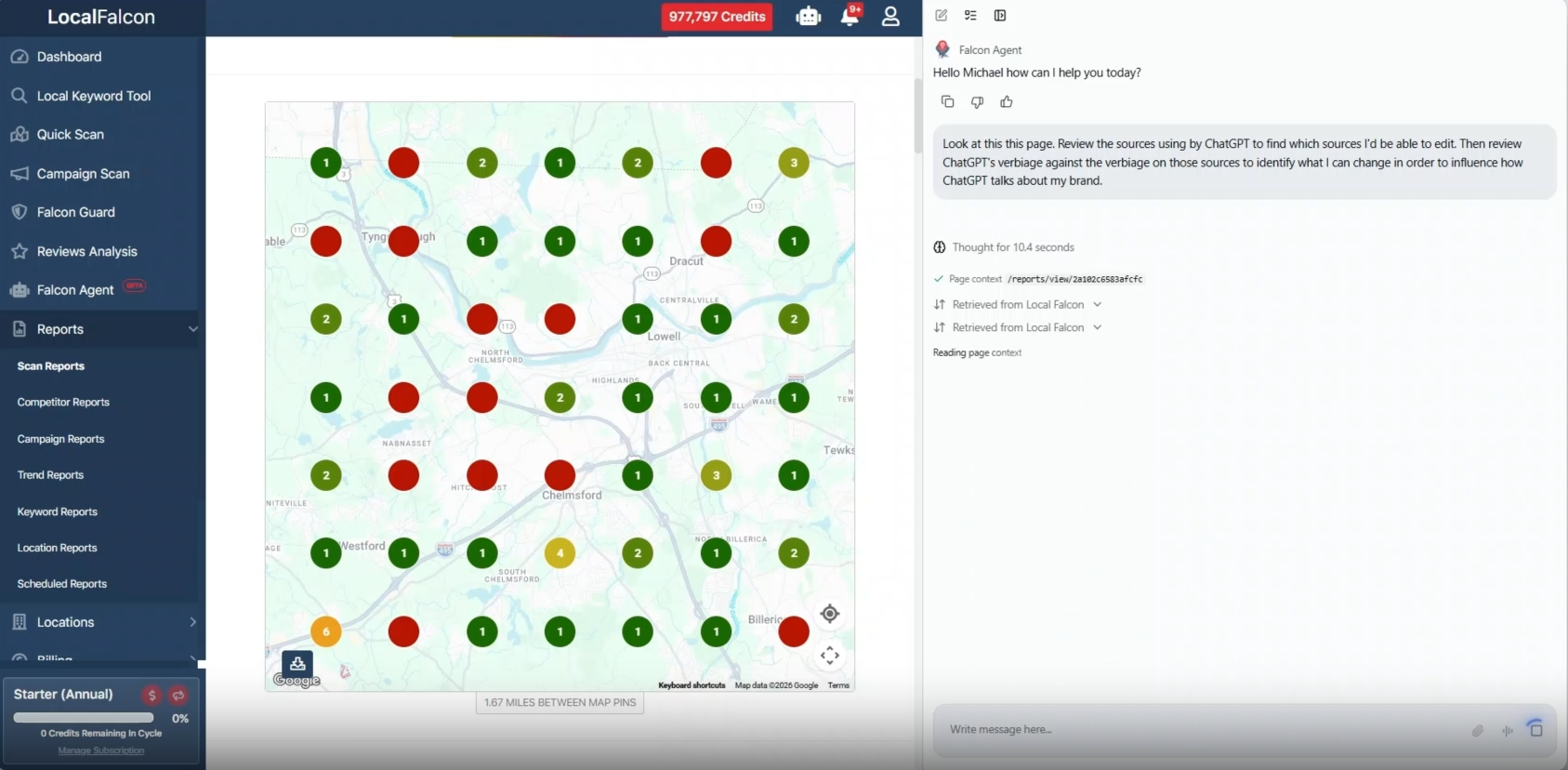
Now, Local Falcon applies that same geo-grid method to AI search. You scan one AI engine at a time — ChatGPT, Gemini, Google AI Overviews, AI Mode, or Grok — and it samples the AI’s answers across a grid of points around your location, then reports your Share of AI Voice, average position, a Buyer Persuasion Score for sentiment, the competitors that appeared, and the sources the AI cited.
How location-specific those answers are depends on the engine: Google’s AI Overviews and AI Mode factor in location most directly, while the chat engines vary more by how a prompt is phrased than by exact map point.
The main drawback is the credit model, and it hits AI scans the same way it hits map scans: every grid point costs one credit, per keyword, per platform. A recommended 11×11 grid is 121 credits for a single keyword on a single engine, so tracking several prompts across all 5 engines on a schedule burns credits quickly, and unused subscription credits don’t roll over.
I’d recommend Local Falcon most to local SEO agencies, multi-location businesses, and anyone who needs to understand visibility market by market. If local search isn’t a major part of your strategy, you probably won’t get as much value from its most unique features.
Pros
- Visualize local rankings with geo-grid heatmaps that are easy to understand and share with clients
- Set up scans quickly without a steep learning curve
- Schedule recurring scans to monitor local visibility over time
- Get responsive support through live chat
- Create detailed, customizable white-label reports for clients
Cons
- Frequent scans and larger grids can burn through credits quickly
- Unused subscription credits don’t roll over
- Geo-grids are limited to square shapes
- Some reviewers question the accuracy of newer AI visibility insights
Features
- Geo-Grid Rank Tracking – Map your local rankings across a service area on Google and Apple Maps using Share of Local Voice (SoLV)
- AI Search Visibility – Run geo-grid scans for one AI engine at a time (ChatGPT, Gemini, AI Overviews, AI Mode, Grok), sampling multiple answers per prompt, with Share of AI Voice, sentiment (Buyer Persuasion Score), and the sources the AI cited
- AI Search Source Tracking – See which websites and sources AI platforms cite when they mention your business
- Falcon AI – Turn local rank and AI visibility data into prioritized recommendations you can act on
- Falcon Agent – Automate Google Business Profile management, review responses, posts, scans, and reporting on a schedule
- Falcon Guard – Monitor your Google Business Profile 24/7 and detect or restore unauthorized changes
- AI Reviews Analysis – Analyze your reviews and competitor reviews for sentiment, recurring themes, and areas to improve
- Local Keyword Tool – Research local keywords for traditional and AI search using Local Falcon’s WYN score
- Integrations and API – Connect your data through Looker Studio, Zapier, n8n, REST API, MCP server, and Claude
Pricing
Local Falcon uses a credit-based pricing model, with unlimited keywords and locations on every plan. Here’s how it breaks down:
- Starter – $24.99/month (or $299.88/year billed annually) for 7,500 credits a month
- Basic – $49.99/month (or $599.88/year billed annually) for 15,150 credits a month
- Pro – $99.99/month (or $1,199.88/year billed annually) for 31,250 credits a month
- Premium – $199.99/month (or $2,399.88/year billed annually) for 63,150 credits a month
An AI or map scan costs one credit per active grid point (a 5×5 grid = 25 credits, an 11×11 = 121), charged per keyword and per platform, so grid size and how many engines you track drive the cost. You get 100 free credits to try Local Falcon, and pay-as-you-go credits never expire (separate from the credits that come with your plan).
Reviews
Local Falcon earns a 4.7 on G2 across 130+ reviews. Users consistently praise its ability to show exactly where a business ranks across an entire service area (instead of relying on one vague ranking number).
The most common complaints involve burning through credits on larger or more frequent scans, limited grid customization, and needing some experience to interpret the data correctly.
Here’s what John S. had to say about using Local Falcon:
“Local Falcon allows me to create geogrid reports and competitor reports that are much more detailed and customizable than other similar tools. I got my most recent client just from showing him his business vs his competitors for a major keyword in a Local Falcon report.”
AI Rank Tracker FAQ
What is an AI rank tracker?
An AI rank tracker monitors whether your brand and website appear inside answers generated by platforms like ChatGPT, Google AI Overviews, Gemini, and Perplexity.
Most tools track two types of AI visibility:
- Mentions – When the AI names your brand in its answer
- Links – When the AI cites or links to a page on your website
Tracking both gives you a more complete picture. An AI platform might mention your brand without sending traffic to your site, or cite your content without naming your brand prominently.
How is AI rank tracking different from regular SEO rank tracking?
Traditional rank tracking shows where your pages rank in search results. AI rank tracking shows whether your brand or content appears inside an AI-generated answer.
You need both because ranking number 1 in Google doesn’t guarantee that an AI answer will mention or cite you. At the same time, appearing in ChatGPT doesn’t tell you how your pages perform in traditional search.
Tracking them together helps you see whether your SEO work is improving visibility across both search experiences.
What’s the best free way to check my AI visibility?
You can spot-check your visibility by running your most important prompts in ChatGPT, Perplexity, Gemini, and Google to see whether your brand or pages appear.
That works for a quick look, but it doesn’t scale or show how your visibility changes over time. AI answers can also vary by platform, prompt, location, and date.
A tool with a free trial, like ProRankTracker, lets you track up to 50 prompts for 7 days without paying up front.
How much do AI rank trackers cost in 2026?
The tools on this list start at around $25 to $30 per month for limited monitoring and climb to several hundred dollars per month for broader platform coverage and enterprise features.
Don’t compare the starting prices alone. Check how much you’ll pay after adding:
- More prompts
- Additional AI platforms
- Extra domains or projects
- More users
- Reporting features
- A required base SEO subscription
A low entry price can become expensive quickly once you configure the tool for your actual tracking needs.
Which AI platforms should I track?
Start with where your audience is. AI Overviews and AI Mode matter for Google searchers; ChatGPT has the largest user base at around 800 million weekly users, but Perplexity, Gemini, and Copilot are growing fast.
Start Tracking Your AI Visibility
If you can’t see where you show up in AI answers, you’re optimizing blind while your competitors get cited in your place.
ProRankTracker closes that gap. You track your AI visibility and your organic rankings daily, in one accurate tool, with reporting your clients can actually read.
Start a free trial and track 50 prompts a day for 7 days, every premium feature on, no credit card required. See exactly where you stand, then go win those answers back.