
AI Mentions vs. AI Links: What Each Metric Tells You
Open an AI answer and there is your brand, right in the middle of the recommendation.
Great news. Except there is no link.
Then you check another prompt and find the opposite: the AI answer cites one of your pages, but barely mentions the company behind it.
So which result counts as visibility?
Both of them do. They just tell you very different things.
That difference is easy to miss when everything gets rolled into one AI visibility score. ProRankTracker separates the two signals into Mentions and Links, so you can see whether AI platforms recognize your brand, trust your content as a source, or do both.
And yes, the distinction matters. In a Pew Research Center study of 68,879 Google searches, users clicked a source inside an AI summary in only 1% of visits. If you measure AI visibility only by referral clicks, you can miss most of the influence happening before the click.
Let’s look at what each metric actually means and, more importantly, what you should do with the result.
What Is an AI Mention?
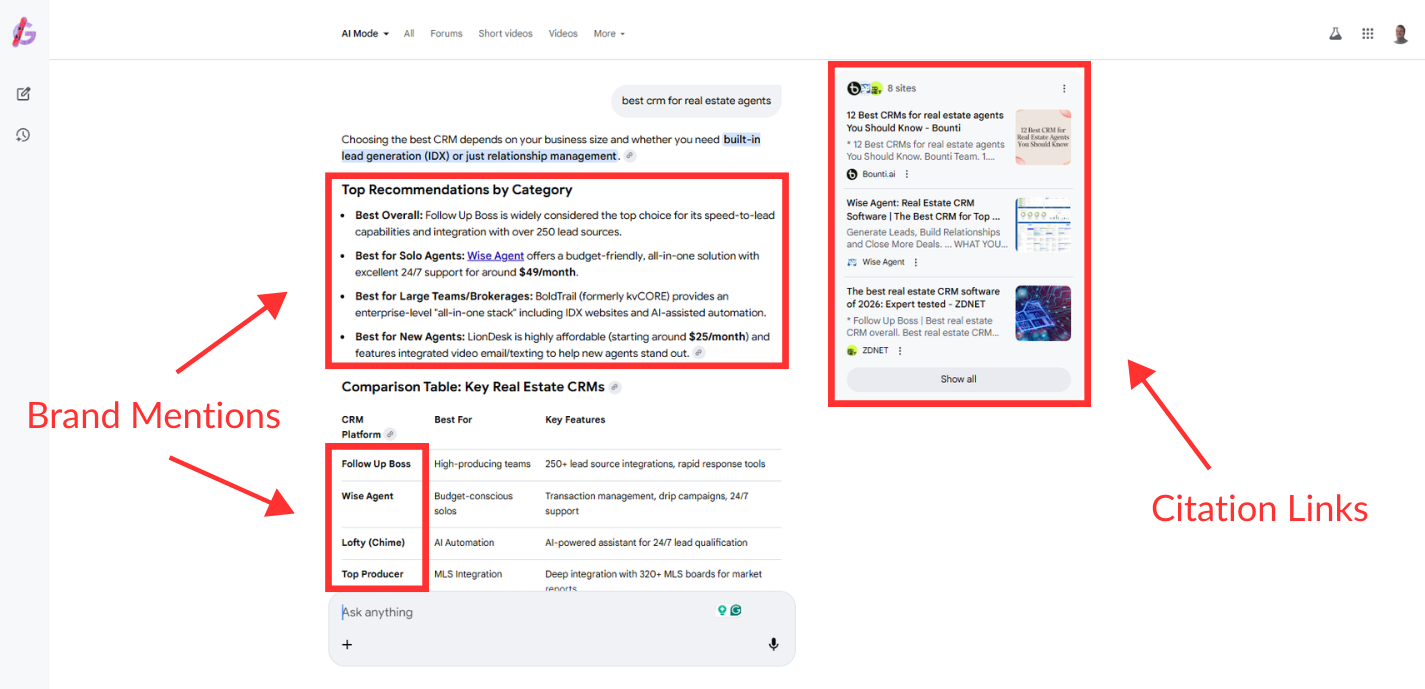
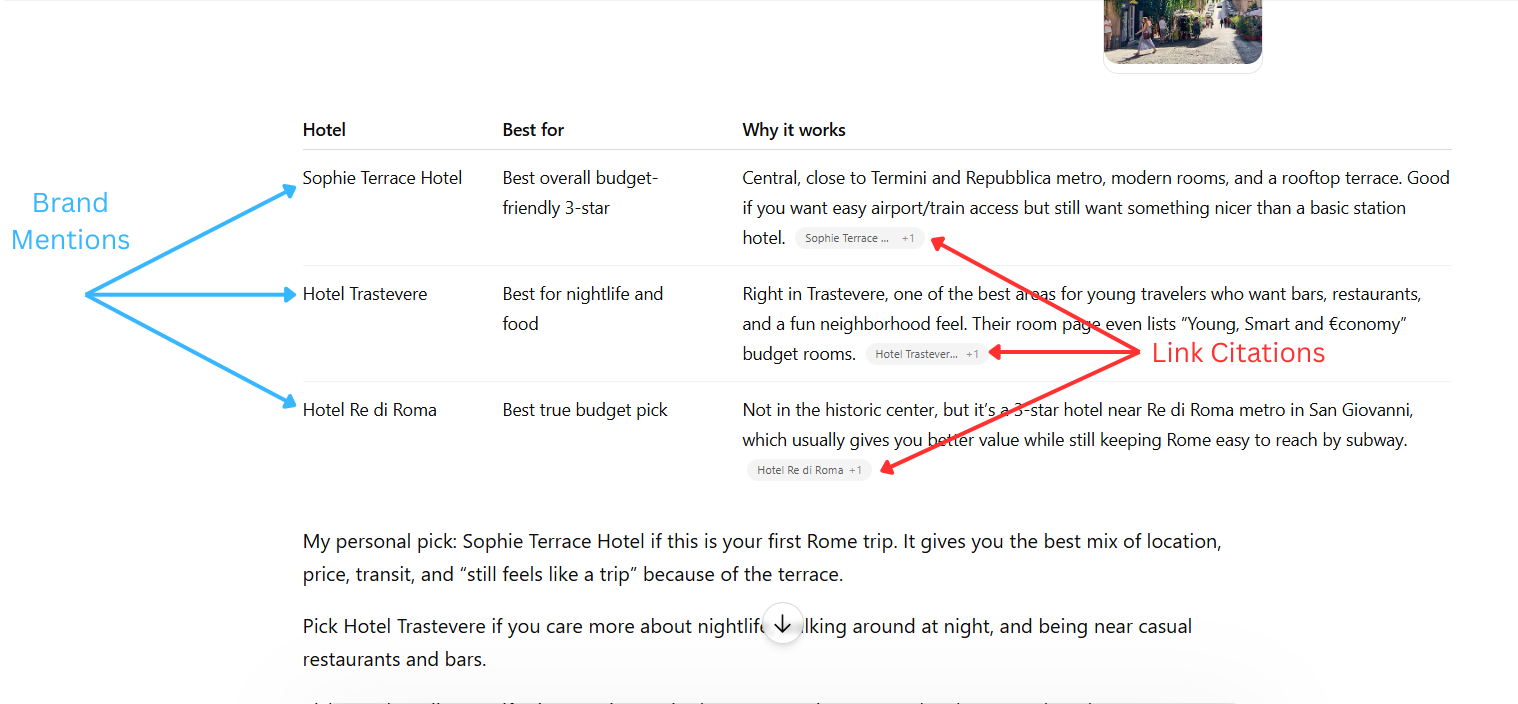
An AI Mention occurs when a tracked brand or product name appears in the text of an AI-generated answer. No link is required.
Imagine someone asks for a good family restaurant near the museum. The answer recommends your restaurant by name, explains that it has a kids’ menu, and then links to a local newspaper roundup instead of your website.
You did not earn the click, but you did make the shortlist. That is still a Mention, and it can influence the buyer before they ever reach a website.
Mentions help you measure whether AI systems associate your brand with a topic, category, feature, problem, or audience. They can reveal visibility that referral analytics and backlink tools cannot see.
What Mentions can tell you
- Whether your brand is included in recommendations
- Which prompts and topics are associated with your brand
- How often competitors are named instead
- The context in which your brand appears
- Whether brand visibility is becoming more consistent over time
Here is the catch: the surrounding sentence matters just as much as the count. A glowing recommendation, a neutral comparison, and a warning are all Mentions. You would not report them the same way.
What Is an AI Link?
An AI Link is an external URL included in an AI-generated answer. It may appear as a citation, supporting source, or another referenced link.
Links answer a different question: which pages did the AI platform select as supporting material?
They can send referral traffic, but even when nobody clicks, they reveal the source material being selected for a prompt. That makes them useful clues for content strategy.
Say somebody asks how to remove red wine from a cotton shirt. The answer may cite a laundry-care guide from a detergent brand without naming the detergent at all. The page earned source visibility. The brand did not necessarily earn a place in the recommendation.
What Links can tell you
- Whether pages from your website are being cited
- Which URLs earn visibility for each prompt
- Where your URL appears among the detected sources
- Which competitor and third-party pages are selected
- Whether new or updated content is gaining source visibility
Do not limit Link analysis to your homepage. Product pages, documentation, tutorials, original research, comparison pages, and help content may each earn visibility for different types of prompts.
AI Mentions vs. AI Links
| Metric | What it detects | Primary question | Typical action |
|---|---|---|---|
| Mentions | Tracked brand or product names in answer text | Does the AI platform recognize and discuss the brand? | Improve positioning, authority, and brand associations |
| Links | External URLs referenced in the answer | Does the AI platform select the website as a source? | Improve source content, evidence, clarity, and relevance |
It is tempting to ask which metric is better. That is the wrong question.
Their value depends on the prompt and the decision the reader is trying to make.
A brand Mention in a product recommendation may influence awareness even without a click. A Link in a research answer may drive qualified visitors even when the brand receives little emphasis. In many commercial prompts, the strongest outcome is earning both.
The Four Visibility Combinations
1. Mention and Link
This is the result everybody wants. The answer names your brand and gives the reader a direct path to your website.
Review the context before celebrating. Confirm that the description is accurate, the cited URL is useful, and the placement matches the prompt’s intent. Then protect that visibility by keeping the page current.
2. Mention without a Link
The AI platform recognizes your brand but does not select your website as a source.
This can happen when third-party sites discuss the brand more clearly than your own pages, or when your site lacks a page that directly answers the prompt. Examine the URLs that were cited and identify the information they provide.
Your next step may be to improve a relevant product page, publish a focused guide, add original evidence, or make existing information easier to find and verify.
3. Link without a Mention
Your content is useful enough to cite, but the brand is not prominent in the answer.
This is valuable source visibility, especially if it produces referral traffic. However, it may also show that the content is stronger than the brand association.
Make authorship and brand ownership clear on the page. Use accurate organization information, consistent branding, descriptive titles, and a strong connection between the page and the company that produced it.
4. No Mention and no Link
Your brand and website are both absent from the tracked answer. Nobody likes seeing this one, but it is often the most useful starting point.
Do not treat one missing result as a crisis. Look at the trend and compare several related prompts. If the absence is consistent, review the brands and sources that do appear. That gives you a practical starting point for content and positioning.
How to Track Mentions and Links
1. Choose decision-focused prompts
Start with prompts connected to discovery, comparison, and purchase decisions. Examples include:
- Best [product category] for [audience]
- [Product] alternatives
- [Product A] vs. [Product B]
- Tools with [important feature]
- How to solve [high-value problem]
Those patterns work far beyond software. Think “best carry-on suitcase for European trains,” “quiet coffee shop for a client meeting,” or “how to stop a puppy chewing furniture.” If the question could change what somebody buys or does next, it is probably worth more than a broad trivia prompt.
A smaller set of meaningful prompts is more useful than hundreds of near-duplicates.
2. Define the names and URLs you care about
List the brand names, product names, spelling variations, domains, and important URLs you want to monitor. Avoid generic Mention terms that could match unrelated text.
3. Track the same prompts consistently
AI answers change. If you keep changing the prompt, you cannot tell whether visibility improved or the question simply changed. Maintain a stable core set and add new prompts separately.
4. Check both signals daily
Weekly or monthly checks can miss short visibility windows. Daily tracking shows when a Mention or Link appeared, disappeared, or returned.
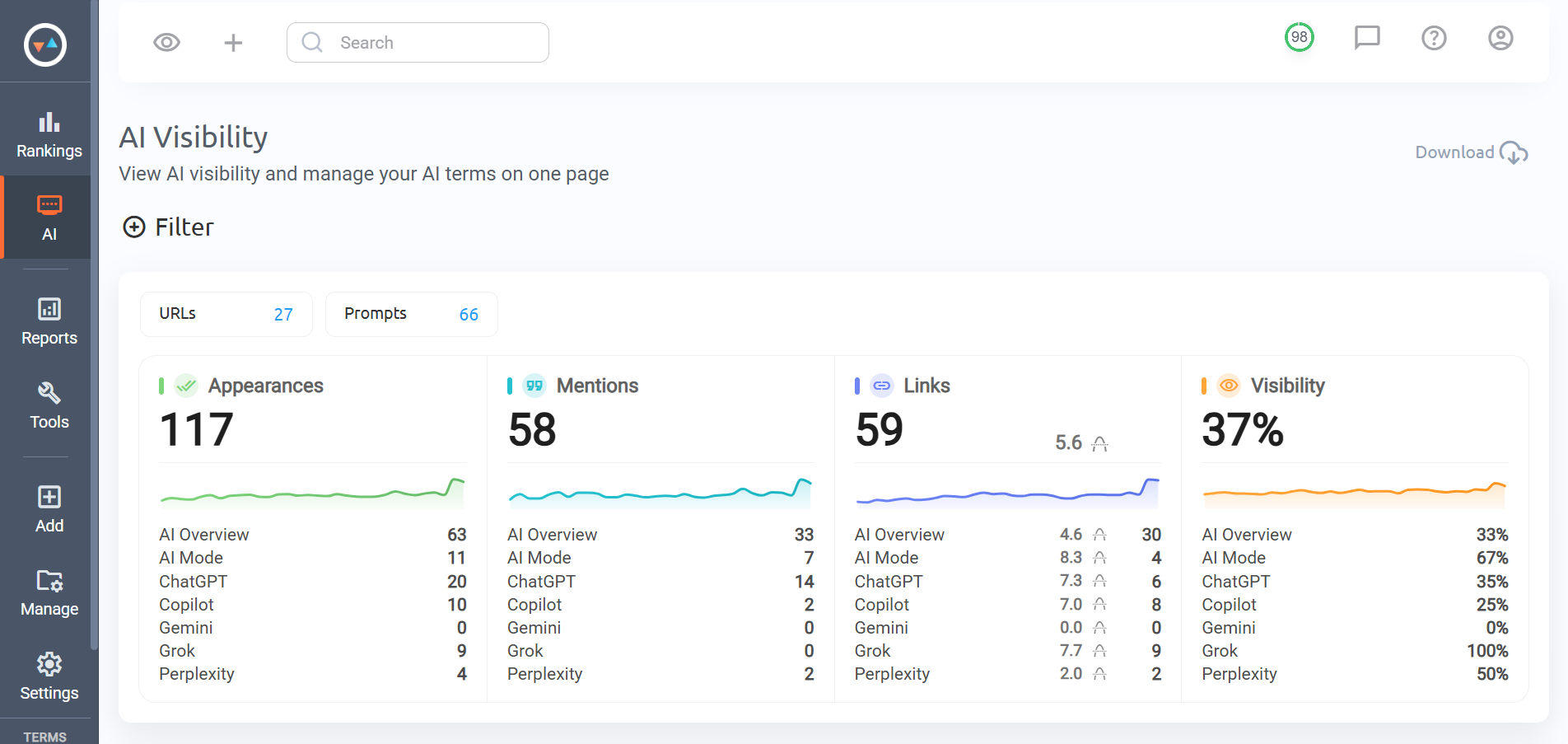
ProRankTracker’s AI Rank Tracker records Mentions and Links across Google AI Overviews, AI Mode, ChatGPT, Gemini, Perplexity, and Copilot. The same account can also track organic, local, and video rankings.
5. Organize prompts by intent
Use Projects and Tags to separate category, feature, comparison, problem, and branded prompts. This helps you identify where the brand is strong and where it is consistently absent.
How to Analyze the Results
Measure coverage, not just totals
Ten Mentions from one prompt do not equal visibility across ten high-value prompts. Measure how many tracked prompts produce a Mention or Link and how consistently that happens.
Read the context
A Mention count cannot tell you whether the answer recommends the product, compares it neutrally, or describes it incorrectly. Review the surrounding text and record material problems.
Review the cited pages
Identify which of your URLs appear and which competitor or third-party pages are selected. Look for patterns in page type, freshness, evidence, structure, and topical focus.
Compare platforms separately
Do not assume a prompt will produce the same sources and brands everywhere. Each platform can return a different answer. Even Google’s AI Overviews and AI Mode may show different sources because, as Google explains in its AI features documentation, they can use different models and techniques. Compare results by platform before combining them into an overall summary.
Connect changes to your work
Record important content updates, campaigns, product launches, and outreach activity. When visibility changes, those notes help you investigate possible causes without claiming that correlation proves causation.
How to Improve Mentions
- Clarify what your brand does and who it serves.
- Build consistent associations between the brand and its product category.
- Earn accurate coverage on relevant third-party sites.
- Publish useful expert content instead of generic summaries.
- Keep company, product, and organization information consistent.
- Correct outdated or misleading descriptions when you can.
The goal is not to repeat the brand name unnaturally. It is to create clear, credible evidence that connects the brand with the problems it solves.
How to Improve Links
- Answer the prompt directly near the beginning of the page.
- Include original data, examples, and verifiable details.
- Use descriptive headings and short, focused sections.
- Keep important information available as text.
- Update claims, dates, screenshots, and product details.
- Use internal links so relevant pages are easy to discover.
- Make the page indexable and eligible to appear in search.
A page should be worth citing even if the reader has never heard of the brand.
Frequently Asked Questions
Is an AI Mention the same as a backlink?
No. A Mention is a tracked name in the answer text. It may appear without any link to the brand’s website.
Is every AI Link a formal citation?
No. ProRankTracker’s Links signal includes detected citation links and other external URLs referenced in the answer.
Which metric should agencies report?
Report both. Explain Mention coverage, Link coverage, important cited pages, competitor visibility, changes over time, and the actions planned for the next period.
Can Search Console separate AI Overviews and AI Mode?
No. Google currently includes traffic from its AI features within the Web search type in Search Console. Dedicated AI tracking provides a separate view of prompts, Mentions, and Links.
Track the Full AI Visibility Picture
A Mention means you made it into the conversation. A Link means your content helped support the conversation.
Those are not interchangeable wins. Tracking only one leaves half the story hidden and can send your next content decision in the wrong direction.
Use ProRankTracker to monitor both signals daily, compare platforms, review competitors, and connect AI visibility with the organic rankings you already track.