
How to Prove the ROI of AI SEO to Leadership in 6 Steps
Proving your SEO ROI is harder than ever.
With AI Overviews and chatbots answering user queries directly, your click-based metrics are likely flat or declining, making it tough to defend your budget.
But here’s the kicker: that “lost” traffic isn’t really gone. It’s reappearing as high-intent direct visits after users see your brand in an AI answer and search for you by name.
This is the new “dark SEO funnel,” and it’s where the real value is hiding. Old, last-click attribution models will miss this entirely.
That’s why I’ve put together a simple, CFO-proof framework to connect this new AI visibility to defensible business metrics like pipeline and revenue.
In the sections that follow, I’ll walk you through:
- Step #1: Track Attributable AI Conversions in GA4
- Step #2: Uncover the “Dark Funnel” with Self-Attribution
- Step #3: Track the AI Visibility That Actually Drives Revenue
- Step #4: Connect AI Visibility to the “Dark Funnel”
- Step #5: Build a Single, Compelling ROI Story
- Step #6: Communicate Your AI-Driven Wins to Leadership
- Frequently Asked Questions About Proving AI SEO ROI
Step #1: Track Attributable AI Conversions in GA4
Most of the AI buyer journey happens before someone ever clicks your website. That’s the frustrating part.
But there’s still a measurable slice you can prove — when someone clicks a citation link inside ChatGPT, Perplexity, Copilot, or Gemini and lands on your site. That traffic shows up in GA4.
And the data is showing it’s usually high intent. For instance, a Semrush traffic study found the average LLM visitor is worth 4.4 times more than the average visitor from traditional organic search. The story is even more dramatic at Ahrefs, where their own data shows AI search visitors convert at a 23x higher rate and drive over 12% of all signups from just 0.5% of total traffic.
This attributable AI data matters because it gives you something concrete. Instead of saying, “I think AI is influencing buyers,” you can point to sessions, conversions, and revenue tied to AI referrals. Even if the volume is small compared to Google Organic, the conversion rate is often significantly higher. That alone can justify deeper AI SEO investment.
To find it, go to GA4 → Reports → Acquisition → Traffic acquisition.
Filter by Session source / medium and search for traffic coming from major AI platforms like:
- ChatGPT
- Gemini
- Perplexity
- Copilot
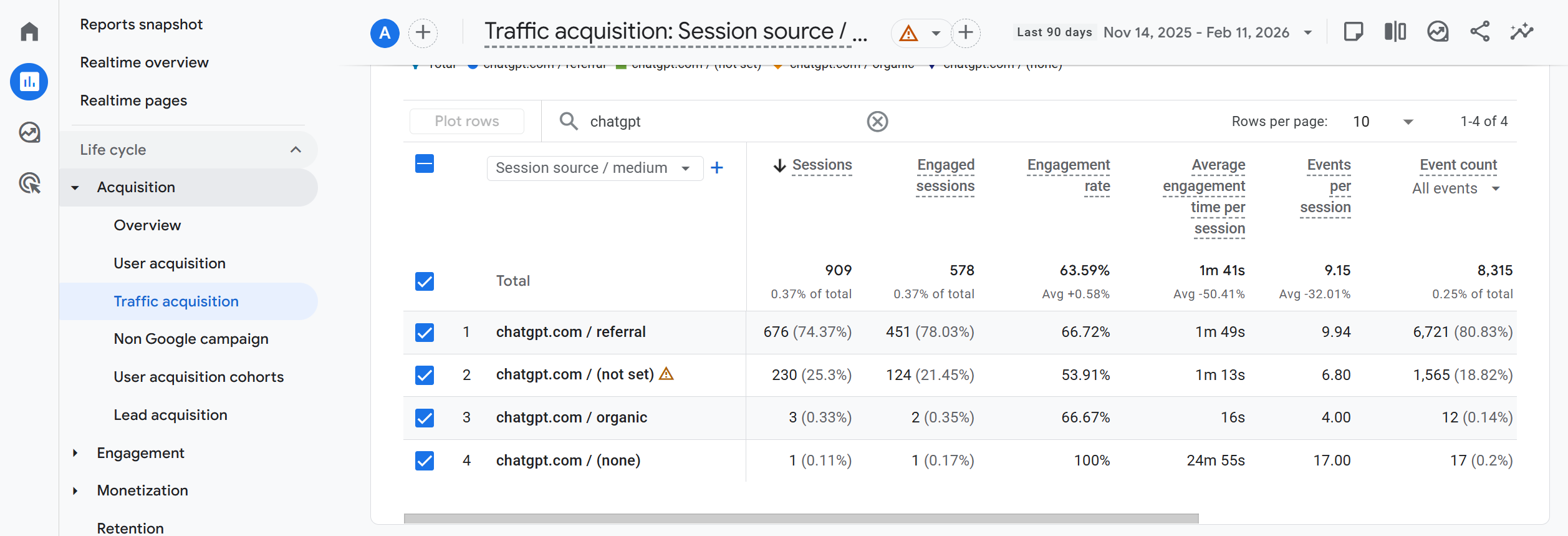
Create a comparison or custom segment for those sources. Then review:
- Sessions
- Conversions (or key events)
- Conversion rate
Next, add “Landing page + query string” as a dimension. This shows you exactly which URLs AI platforms are sending traffic to.
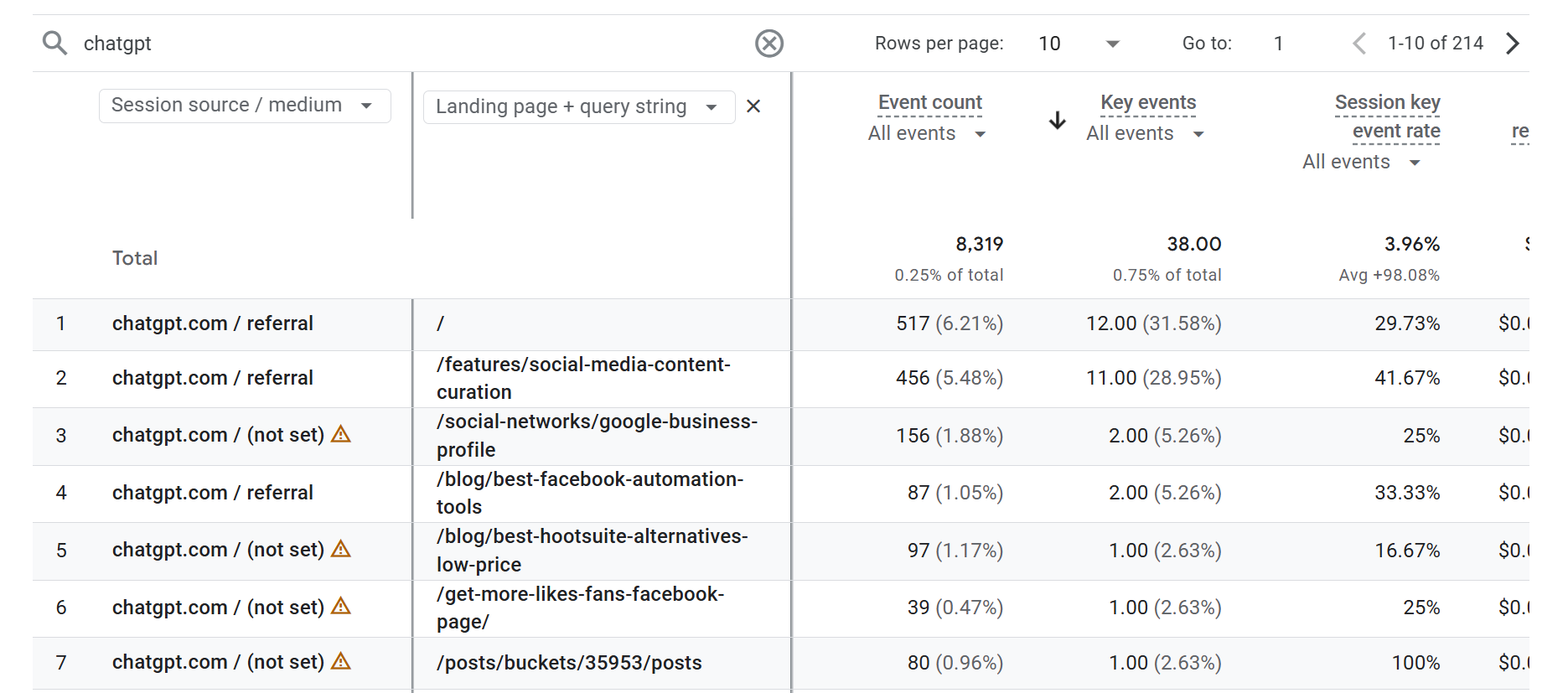 Those pages tell you what topics and formats are resonating with LLMs — and what you should double down on.
An important note here: Traffic from Google AI Overviews and AI Mode won’t show up cleanly here because most of that traffic still rolls into Google Organic.
This won’t prove the entire ROI of AI SEO. But it gives you hard evidence that AI visibility is already driving measurable business results.
Step #2: Uncover the “Dark Funnel” with Self-Attribution
Here’s the uncomfortable truth: a big chunk of AI SEO impact will never show up cleanly in GA4.
If someone sees your brand in an AI answer from ChatGPT, then Googles your brand, finds your homepage, and then converts, GA4 credits this as Google “organic.” AI gets zero attributable credit in GA4.
That’s the new “dark SEO funnel.”
The simplest way to fix this:
Add a “How did you first hear about us?” field to your key conversion forms — demo requests, contact forms, checkouts, etc. Make it mandatory, but simple to fill out.
To get usable data (instead of garbage answers):
- Use a dropdown list of options
- Include an “Other (please specify)” option
- Keep the question simple: “How did you first hear about us?”
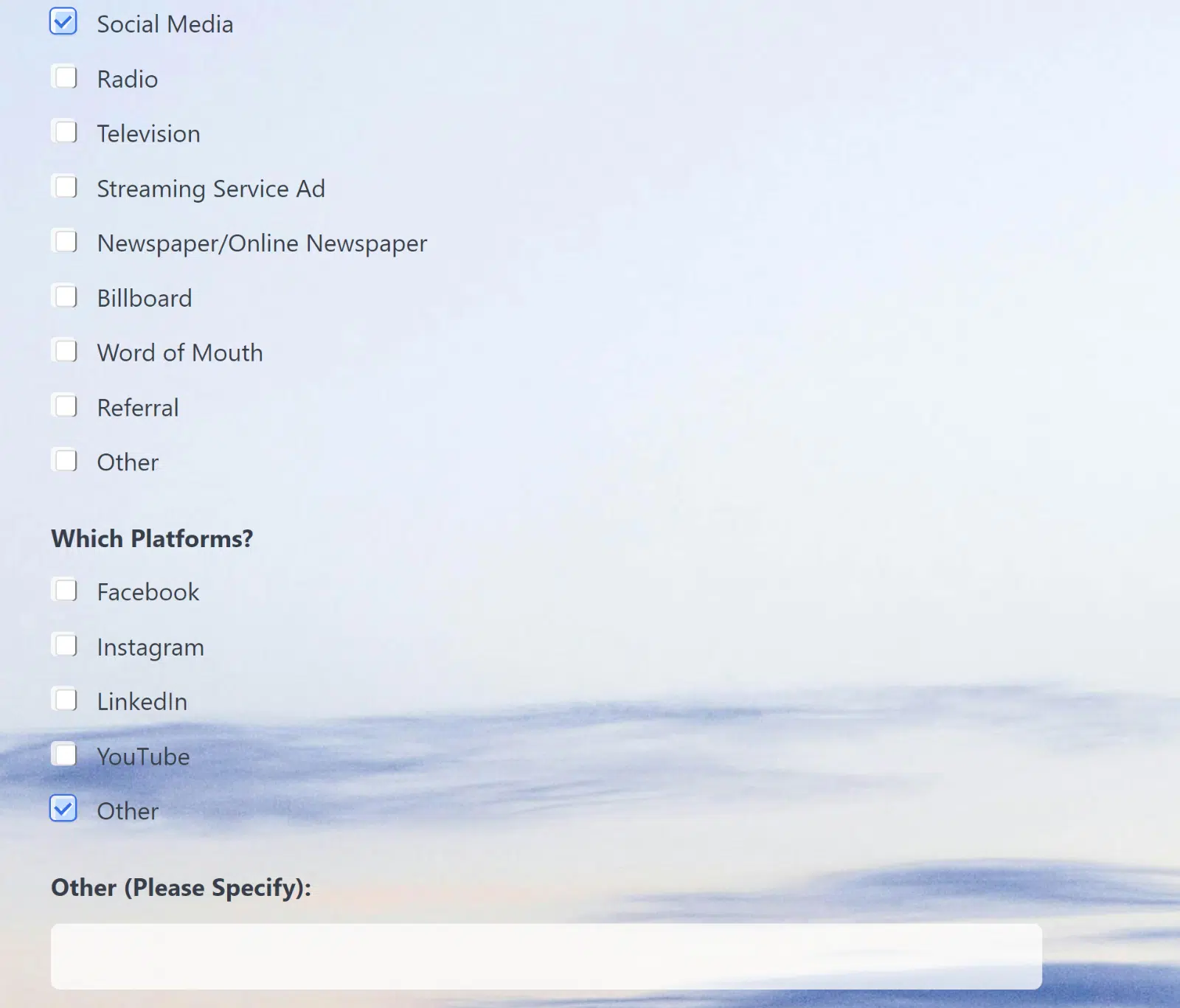
Source: WPForms
Your form options need to reflect how people discover brands today. Generic choices like “Google” are no longer enough to pinpoint the impact of AI SEO.
Update your dropdown list to look something like this:
- AI (e.g., ChatGPT, Gemini, Copilot)
- Advertising
- Google Search
- Social Media (e.g., LinkedIn, X, TikTok)
- Podcast / YouTube
- Friend / Colleague
- Other (please specify)
When customers consistently select “AI” or explicitly type “ChatGPT recommended you,” you now have qualitative evidence that AI visibility is turning into sales.
Once the data starts coming in, centralize it. Push it into your CRM or a simple spreadsheet. Then categorize similar responses into clean buckets (for example, grouping ChatGPT, Gemini, and Copilot under “AI”).
Over time, you’ll be able to spot real patterns of how AI is influencing new customers.
If 8%, 12%, or 18% of new customers are saying they discovered you through AI — you can now confidently communicate that with your leadership or clients.
Sure, self-reported attribution isn’t perfect… people forget where they originally came from and often mistake one channel for another.
But, since the data is qualitative, it can paint a more accurate picture of how leads find you.
Step #3: Track the AI Visibility That Actually Drives Revenue
Too many marketing teams are celebrating any AI visibility right now. A citation here. A random mention there. But not all visibility drives revenue.
If you want to prove ROI, you have to focus on the visibility that shows up when buyers are ready to make a decision.
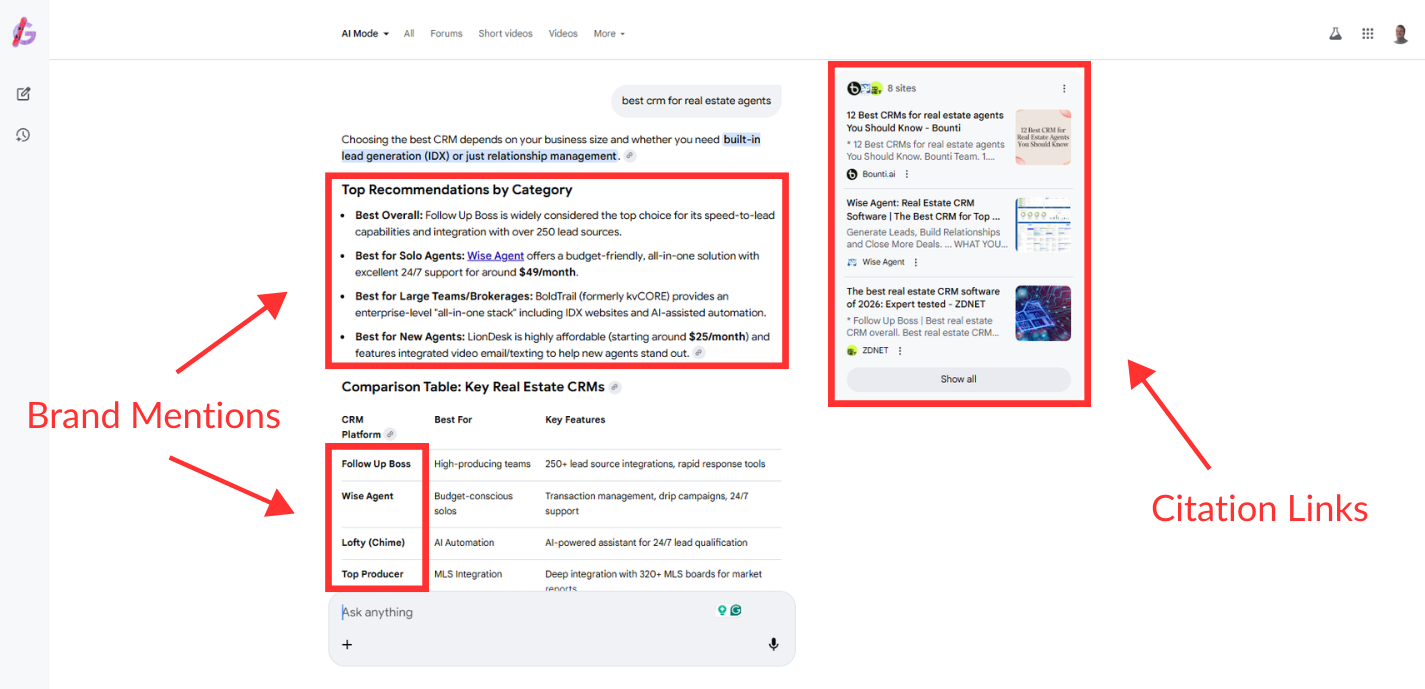
That means having your brand mentioned in bottom-of-the-funnel (BOFU) prompts and searches.
Searches like “best eye doctors in Nashville” or “best gaming PCs under $1000” are what people search when they’re ready to buy. So if your brand is mentioned inside that AI answer, you’re influencing purchase intent directly.
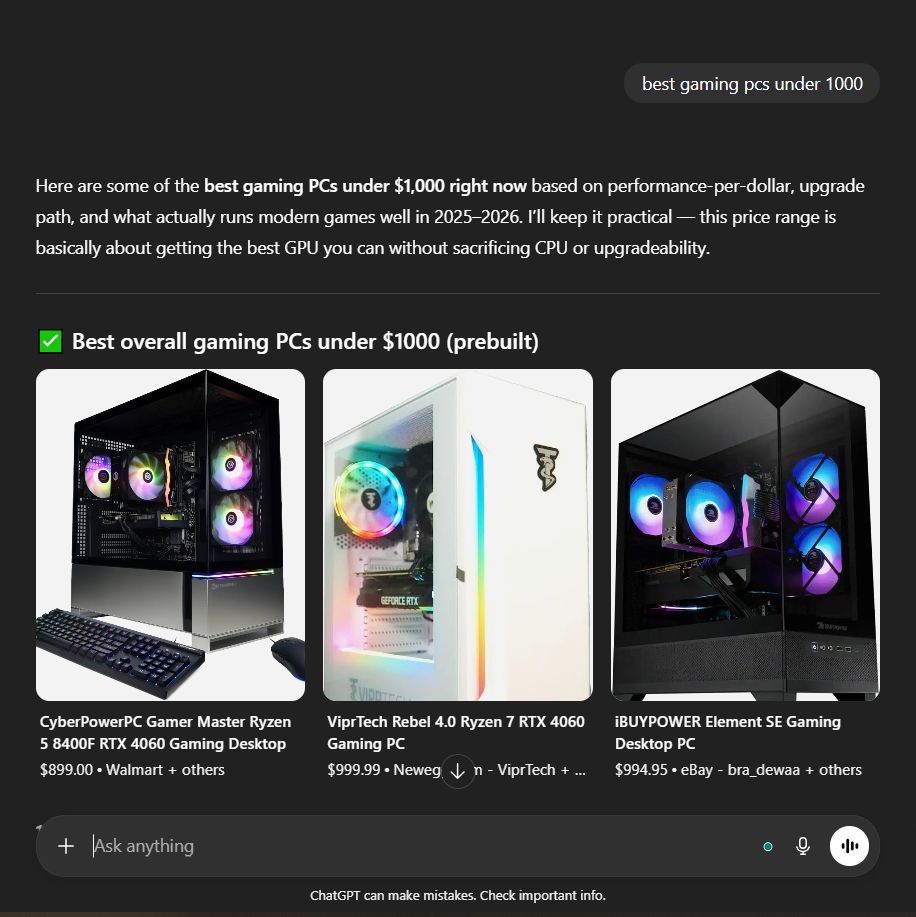
Brand mentions in these BOFU prompts are the metric that fuels the dark funnel (someone finding your brand in an AI answer, then going directly to your homepage without clicking anything in the AI answer).
The problem is you can’t manually search Google AI Overviews, ChatGPT, Gemini, Copilot, and others every week across dozens of searches to see if your brand shows up. You’ll waste hours.
The most efficient way to track this is with an AI visibility tracking tool.
There are LOADS of AI visibility and ChatGPT tracking tools on the market right now, but most of them are either too expensive (like Ahrefs) or too limited (that only track ChatGPT).
Which is why I recommend ProRankTracker as an AI rank tracker. It lets you track both brand mentions and URL citations across all the major AI platforms: Google AI Overviews, Gemini, ChatGPT, Grok, and Copilot.
It’s one of the most affordable and capable AI visibility trackers available, and it combines this with traditional rank tracking so you get a daily view of whether your brand is present — or invisible — in the prompts that matter most.
By the way, if you want to try it out, you can generate an AI visibility report for up to 50 AI prompts right away for just $1 (with the 7-day test run).
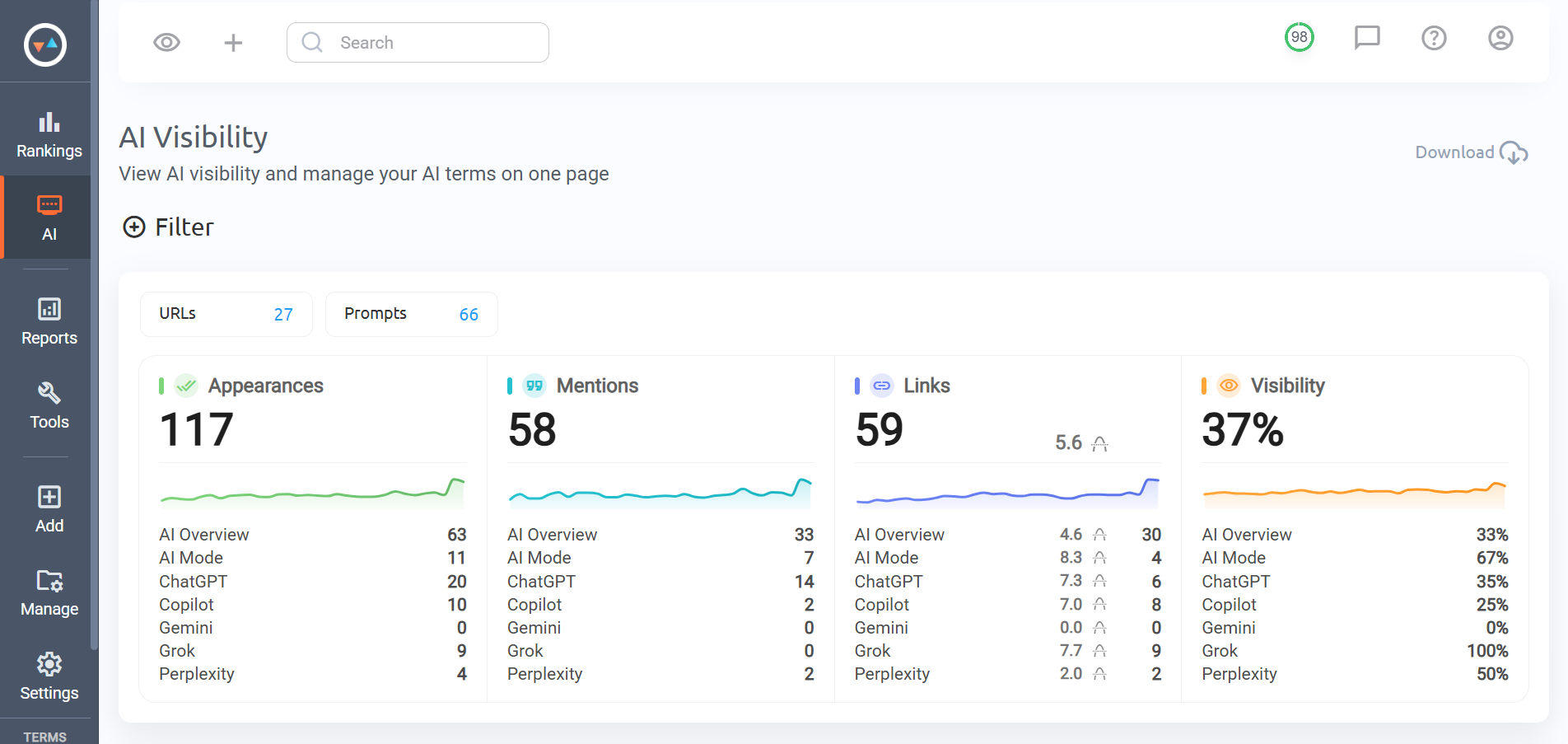 After adding your most important prompts and keywords, you’ll get an overview of your mentions and link citations across all platforms, along with a visibility percentage.
You can also view your AI visibility data more granularly by URL and AI platform.
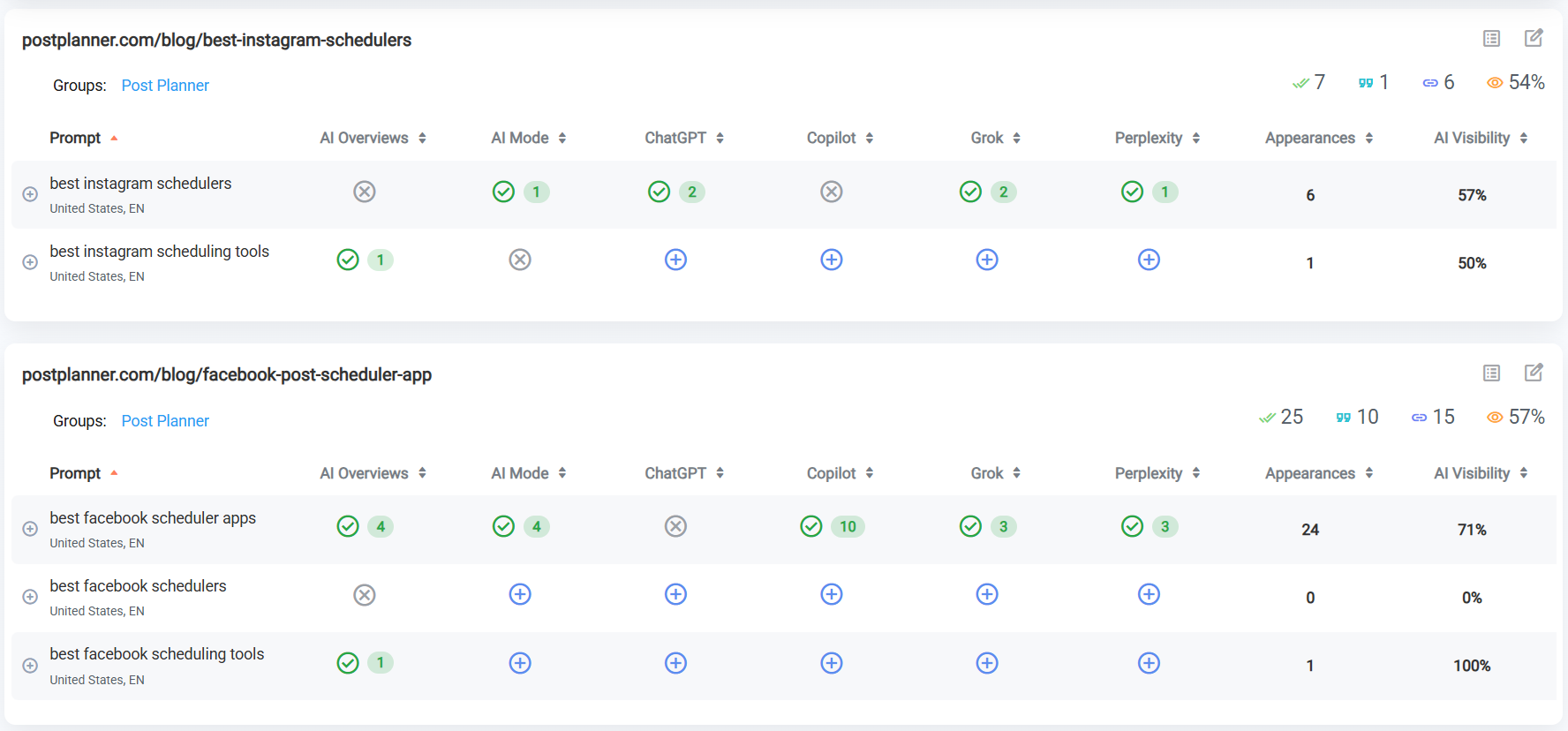
And if you want to share the data, you have options with customizable:
- Shared Reports (a live link report you can share)
- Exports of any view (via PDFs, CSV, XLSX, G-Sheets, and email)
- Scheduled reports sent to any email
My favorite report is the Shared Report because it’s so easy to share with clients. From a simple URL, you get an overview of your AI visibility rankings, and you can break down how you show up on a daily basis.
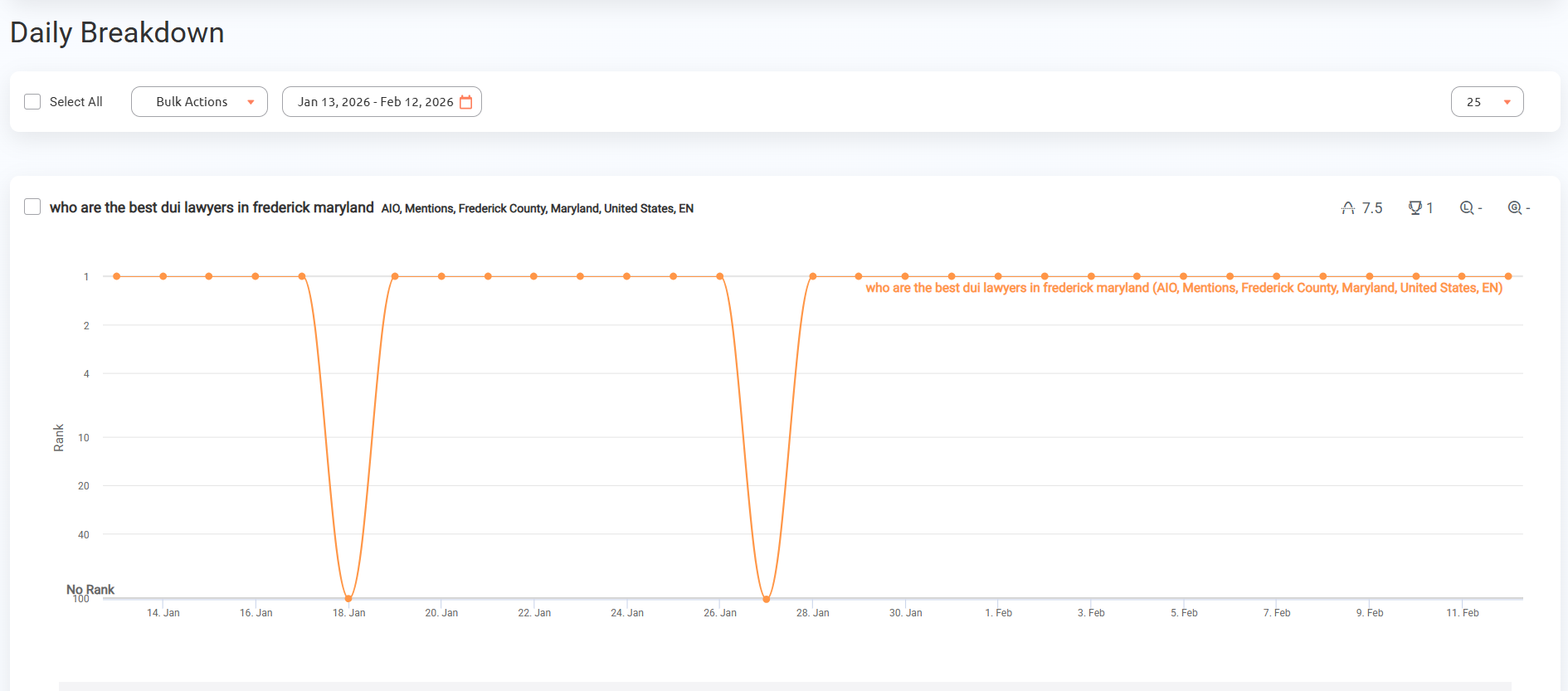
Now, instead of reporting “we’re mentioned in AI answers sometimes.” You can say, “we grew our AI visibility for ‘best dui lawyers in maryland’ from 10% to 25% this quarter.”
That’s already a better way to communicate the value of your AI efforts.
Now, let’s tie it to revenue…
Step #4: Connect AI Visibility to the “Dark Funnel”
You can’t get clean, last-click attribution that says: “AI mention → conversion.” But you can show patterns that are hard to ignore.
The first pattern you should monitor is branded search volume.
Because when someone sees your brand mentioned inside an AI answer for a BOFU query, their next step is searching for your brand. Which shows up as branded queries in Google Search Console.
This is easy to track: simply segment by queries that include your brand name and watch for trends over time — especially after increases in AI visibility for BOFU prompts.
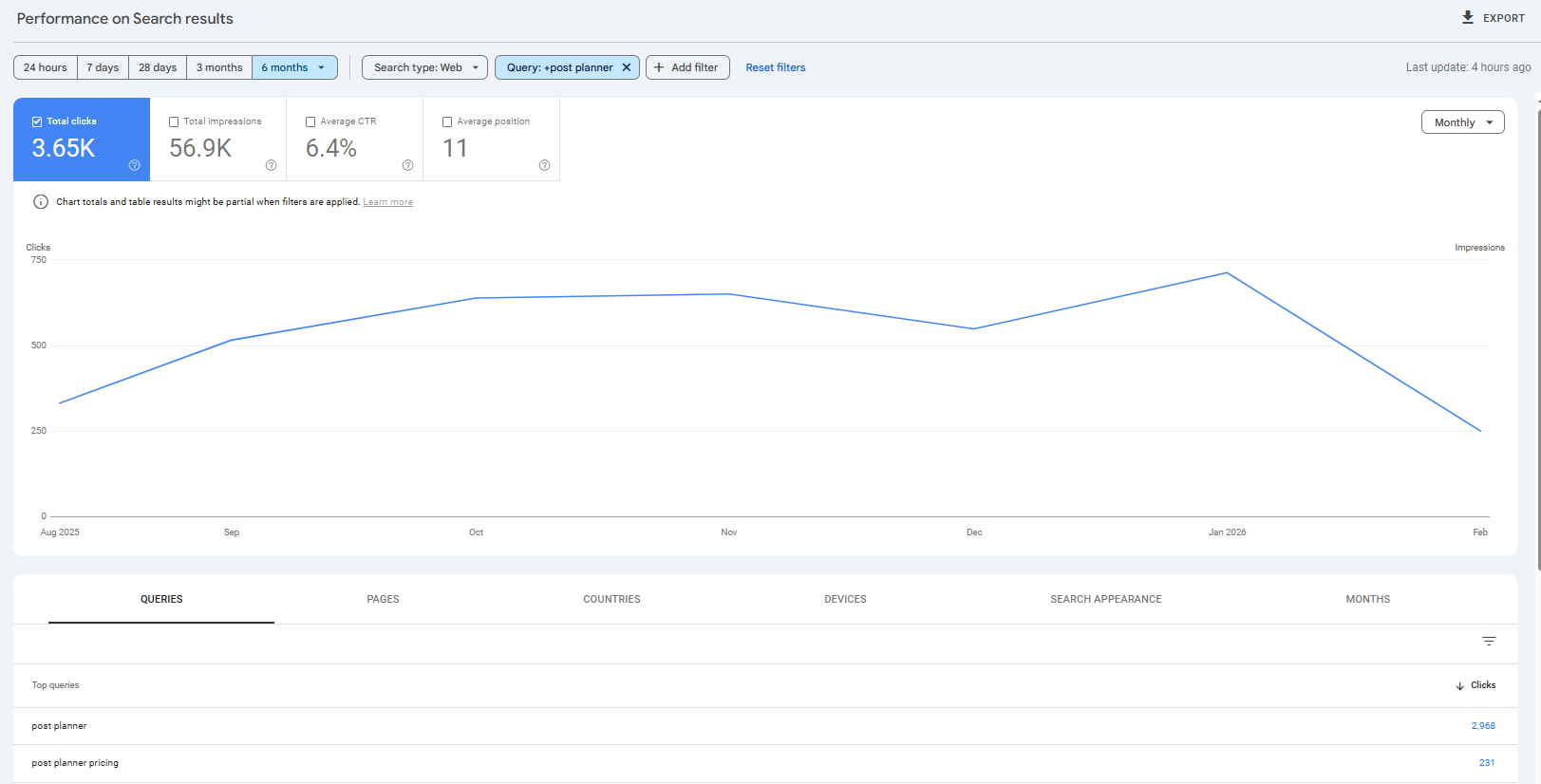
Next, look at homepage traffic and direct conversions in GA4.
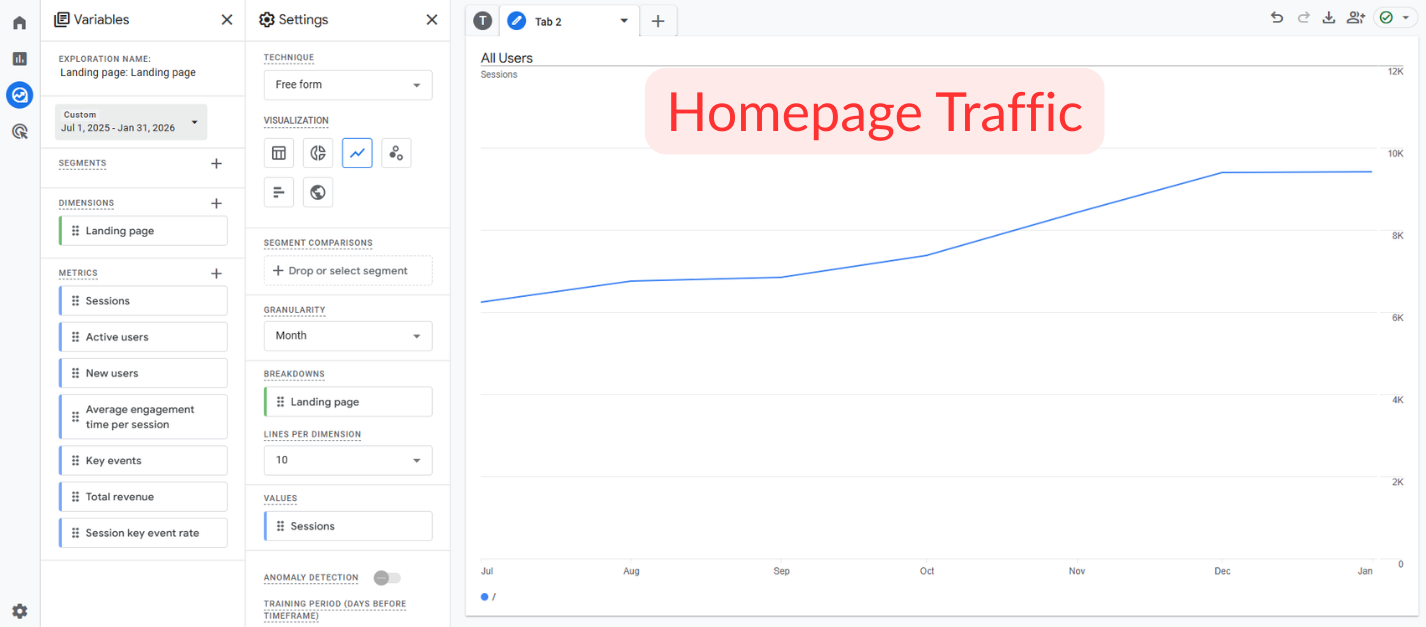
When brand demand increases, homepage visits usually rise too. Check for trends in conversions attributed to “direct” to your homepage. These are classic dark funnel signals.
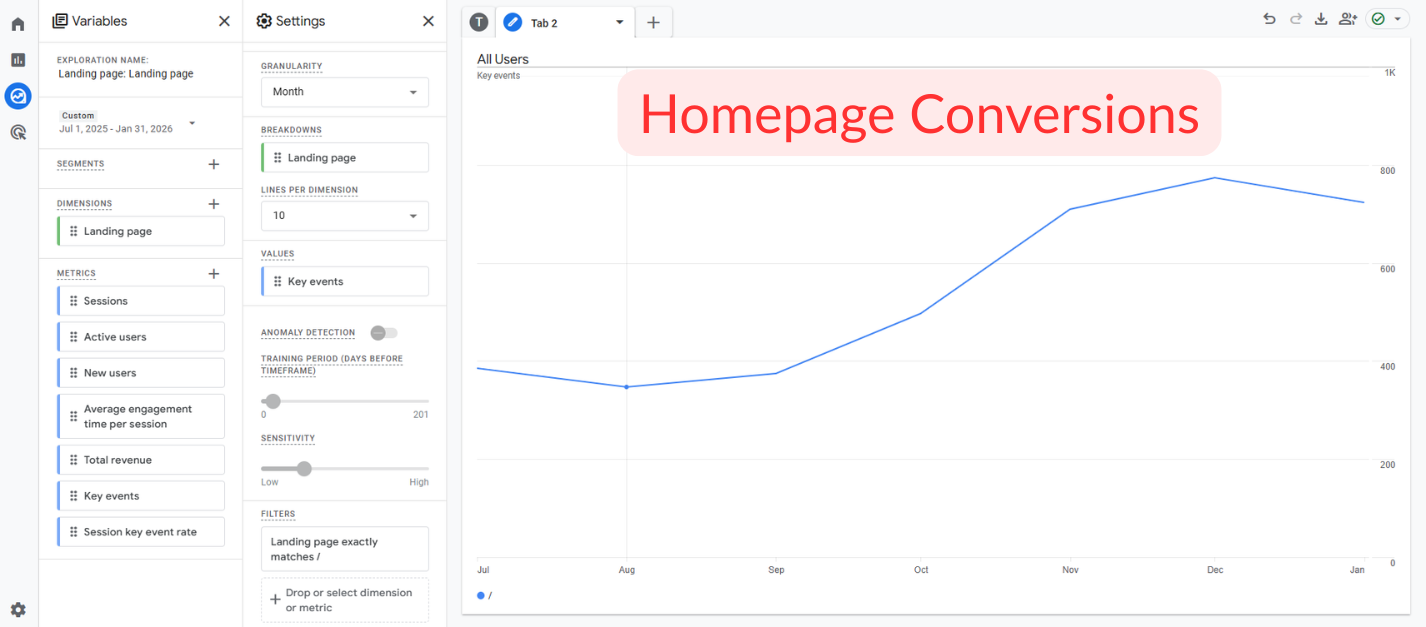
Now here’s where it gets powerful.
Overlay your AI visibility (from ProRankTracker) with:
- Branded search impressions and clicks
- Direct traffic
- Homepage conversions
Looking for correlations. When mentions for high-intent prompts increase, does branded demand rise shortly after? Do sales tick up?
This may not be perfect attribution, but strong, repeated correlation becomes a compelling narrative that makes it easier to communicate ROI.
Instead of saying, “We think AI visibility helped,” you can say:
“The week our brand first appeared in the AI Overview for ‘best project management software,’ our demo requests coming from direct traffic increased by 15%.”
This narrative demonstrates influence, even without perfect click-based attribution.
Step #5: Build a Single, Compelling ROI Story
The final goal is to translate all these different data points into a single, holistic story about revenue and sales, driven by AI search.
If you present AI visibility, branded search, direct traffic, and self-reported attribution as separate charts, leadership will struggle to connect the dots.
Your job is to combine everything into one clear narrative:
AI visibility → brand demand → conversions → revenue.
Creating a Looker Studio dashboard that puts all of this data into one place makes this A LOT easier.
Pull together four core streams:
- AI visibility trends (from ProRankTracker): brand mentions and citations for your BOFU prompts.
- Branded search and direct traffic (from GSC and GA4): are more people actively looking for you?
- Homepage and direct conversions (from GA4): are those visitors turning into demos, signups, or sales?
- Self-reported attribution (from your CRM/forms): how many customers explicitly say they found you via AI tools? (The cherry on top.)
When these sit side by side, the pattern becomes more obvious and easier to communicate the full story of the ROI.
To make your reporting as easy to understand as possible, lead your reports with an executive summary that immediately translates your AI SEO activities into the language of the C-suite: pipeline, revenue, and customer acquisition.
Instead of leading with AI SEO metrics, you want to lead with the likely impact those metrics had on sales. A strong summary follows a simple structure:
- The Outcome: “This quarter, our AI SEO strategy influenced an estimated $500k in new pipeline and helped lower our blended customer acquisition cost.”
- The Why: “We achieved this by increasing our brand mentions in AI answers for key buying-intent searches, which drove a 30% lift in brand search volume and a corresponding increase in high-quality demo requests.”
- The Evidence: “Details on the correlation between our AI visibility, brand search trends, and conversions are outlined below.”
Finally, show the evidence — the overlaid trend lines and the categorized self-attribution data.
The most persuasive part of this entire report is when qualitative and quantitative data point in the same direction. If a measurable percentage of new customers select “AI” as their source, and that cohort converts at a higher rate, you beat any speculation.
Step #6: Communicate Your AI-Driven Wins to Leadership
This is where most SEO teams lose the room.
If you walk into a leadership meeting talking about impressions, mentions, or “AI visibility scores,” you’ve already lost. The only language that matters is revenue, pipeline, and cost of acquisition.
So start there.
Remember, instead of: “Our AI mentions increased this quarter.”
Say: “Our X% increase in AI visibility for buying-intent searches coincided with Y% more branded demand and a Z% lift in sales.”
Leadership doesn’t care about clicks going up or down in isolation. They care whether search is driving revenue.
Then explain the shift in simple terms:
- The old model was: rank → get click → convert.
- The new model is: appear in AI answer → build trust → branded search → convert.
That’s basically the dark funnel you need to explain.
Then, show the data visually from Step #5.
“But what about the decline in clicks???” — your boss, probably
You can address the decline in clicks by explaining:
“Yes, unbranded clicks are flattening. That’s happening industry-wide as AI answers basic questions directly. Our strategy has shifted toward earning visibility in buying-intent AI answers, where conversion intent is higher.”
The key point: fewer low-intent clicks doesn’t mean less impact. It can actually mean better traffic.
If pipeline from search is steady or growing while unbranded clicks decline, that’s okay.
Your role in that meeting isn’t to defend traditional SEO metrics. It’s to show that AI visibility is influencing high-intent buyers — and that the revenue trends support it.
That’s how you protect budget.
Frequently Asked Questions About Proving AI SEO ROI
What is the “dark SEO funnel” and why does it matter?
The dark SEO funnel is what happens when someone sees your brand recommended inside an AI answer, doesn’t click anything, and later comes to your site directly.
From an analytics perspective, it looks like “direct” or branded organic traffic. But the influence started inside an AI result.
It matters because if you only measure clicks, you’ll underestimate AI’s impact. A lot of high-intent influence now happens before the click.
What are the most important metrics for AI SEO?
If you care about revenue, focus on brand mentions in bottom-of-the-funnel prompts.
These are the searches buyers use when they’re comparing options. When your brand appears in those answers, you’re influencing purchasing decisions, which is more important than traffic.
Citations (when your URL is linked as a source) are still valuable. They signal authority and can drive attributable referral traffic. But mentions in buying-intent answers tend to have the biggest downstream impact.
Why can’t I just use GA4 to track AI SEO performance?
GA4 can capture referral traffic when someone clicks a link from a chatbot. That’s helpful — but it’s only part of the picture.
It cannot see someone who reads an AI Overview, remembers your brand, and later searches for you directly. That entire journey looks like “direct” or “organic” in analytics.
My organic traffic is flat or declining. How do I explain this to leadership?
Start by acknowledging the industry-wide shift. AI answers are absorbing more informational clicks across the industry. That’s not unique to your site.
Then pivot to business impact. If branded searches, direct traffic, and conversions are holding steady or growing — especially alongside increased AI visibility — that’s the story to focus on.
Flat traffic doesn’t automatically mean flat revenue. In many cases, it means fewer low-intent clicks and more qualified buyers influenced upstream.
Ready to Turn AI Visibility into Reportable ROI?
If you can’t show how your brand is performing inside AI answers — and how that visibility connects to demand — your SEO budget is exposed. Declining clicks with no clear story is how budgets get cut.
The first step is simple: baseline your AI visibility today.
With ProRankTracker, you can see where your brand is (and isn’t) mentioned across Google AI Overviews, ChatGPT, Gemini, Copilot, Grok, and more.
ProRankTracker gives you that visibility in one place — alongside your traditional rankings — so you can finally answer three critical questions:
- Are we showing up in high-intent AI answers?
- Are we gaining or losing visibility vs competitors?
- Is that visibility increasing over time?
Sign up for a $1 test run to generate the AI visibility reports you need today.